Navigating uncertainty with confidence: How AI enables scalable lending operations
Rethinking readiness
The financial industry is caught in a perpetual balancing act. One month, macroeconomic signals point toward growth and rising demand for credit. The next, a regulatory shift or unexpected economic headwind prompts lenders to tighten their belts. In this type of environment, the real question isn’t if change will occur, but how quickly you can pivot when it does.
For many lenders, this boils down to operational readiness. The days of static, long-term capacity planning are over. Now, institutions are seeking infrastructure that scales in sync with real-world conditions—an approach that lets them capture opportunities in good times and streamline costs in lean periods. Here, AI-powered data and analytics platforms prove invaluable, transforming tedious processes and giving teams the real-time agility they need to stay competitive.
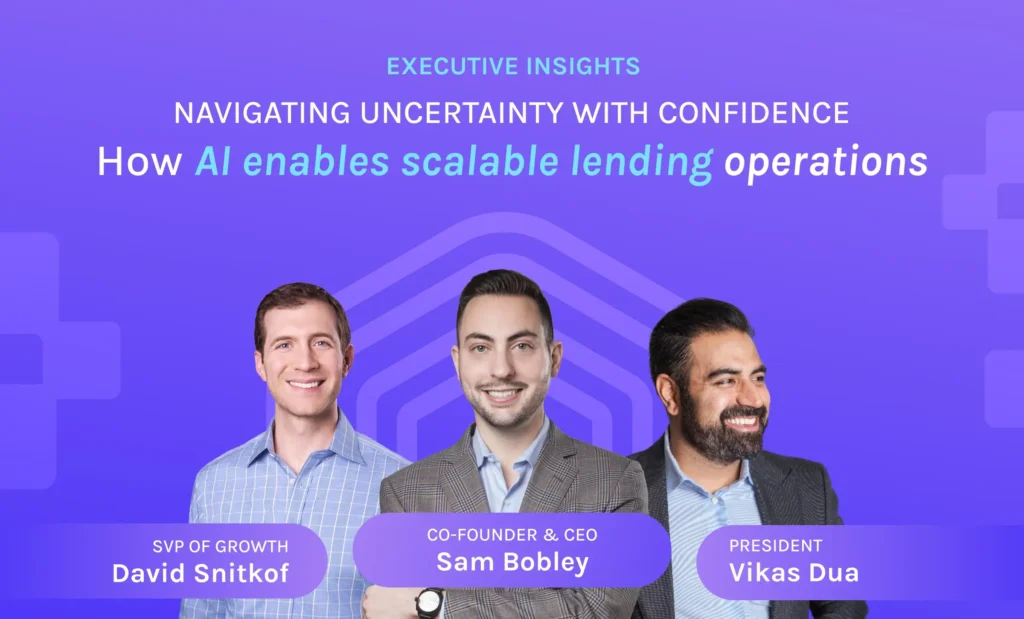
In this edition of Executive Insights, Ocrolus President Vik Dua, SVP of Growth David Snitkof and Co-founder & CEO Sam Bobley explore how AI in lending is enabling operational agility, from document automation to smarter workflows, so teams can focus on growth rather than firefighting.
Vik: Flexibility as a strategic asset
“Flex up” and “flex down” represent more than trendy jargon— they serve as a model for dynamic resource allocation in an environment defined by rapid change. When markets expand and borrower demand surges, lenders want the infrastructure to accommodate that extra volume without adding excessive overhead. When activity slows, perhaps triggered by rising interest rates or tighter credit conditions, lenders need to scale back easily and avoid unnecessary expenses.
This is where Ocrolus’ usage-based infrastructure shines. Rather than buying and maintaining inefficient fixed systems that may sit idle, you tap into an adaptable platform. You pay primarily for the capacity you use and you’re never caught off guard by sudden fluctuations in loan volume. As an added bonus, operational teams can devote more focus to strategic concerns, like risk management or product innovation, instead of wrestling with headcount planning. A recent article from Forbes underscores how AI is streamlining lending operations by reducing manual workloads and improving decision accuracy—outcomes that align directly with usage-based infrastructure models.
For any business leader, this elasticity isn’t just about cost savings. It becomes a strategic asset, granting you the freedom to respond decisively to macroeconomic trends, competitive pressures or even unexpected market shocks. This approach is gaining traction in mortgage lending, but the underlying principle applies across all verticals.

David: Building AI-enabled lending processes with change in mind
Macro conditions change quickly, and so should a lender’s approach to risk assessment, underwriting and fraud detection. That’s the promise of AI-enabled lending infrastructure: it blends data analytics with automated workflows to help teams make rapid, well-informed decisions—even when the market is shifting beneath their feet.
Lending processes typically rely on a series of linear steps, often executed manually. But machine learning models can expedite everything from data extraction to borrower validation, shaving precious hours or days off decision cycles. Ocrolus clients are increasingly applying automation across their lending stacks, from high-volume small business loans to nuanced commercial credit lines and mortgage applications. Lenders that build the operational and technical capacity for nimble change management are able to layer in macroeconomic changes or sector-specific impacts in time for them to make a difference.
Equally important is how AI-powered workflows free organizations from “set it and forget it” system updates. The best lenders are able to build continuous learning machines that can adapt to a variety of economic conditions. These companies are able to adapt if a new regulatory measure demands that lenders capture additional borrower attributes, or if a sudden change in economic forecasts alters your credit policy, your AI-driven system can be recalibrated in real-time. That’s key to thriving in markets where a “quarterly update” might already be too late.
Sam: Scaling without complexity
In any market cycle—whether booming, tightening, or somewhere in between—lenders aim to stay focused on three priorities: delivering great customer experiences, managing risk and driving smart growth. But too often, operational and technical complexity pulls attention away from those goals.
From adapting to new regulatory requirements to scaling staff based on loan volume to enriching data in response to macroeconomic shifts, the day-to-day burden of maintenance work can quickly become overwhelming.
That’s where Ocrolus comes in. Our AI-powered data and analytics platform automates time-consuming tasks like document review, fraud detection and credit risk analysis—freeing lenders to focus on strategy, not firefighting. Ocrolus integrates seamlessly with existing systems like LOS and CRM platforms, serving as a flexible, scalable foundation that adapts with your business in real time.
The result? Confidence. Confidence to launch new products, explore emerging segments and pivot as market conditions evolve—without breaking your budget or reorganizing your workforce every quarter. This is what it means to scale with precision, not pain.
Hear how Kapitus streamlines lending with Ocrolus’ AI-powered data and analytics
Final thought
Financial markets will always have high and low tides. The lenders that excel are those equipped with flexible, AI-powered infrastructure designed to adapt. Instead of making expensive, long-term bets on capacity that may never be fully utilized, institutions can “flex” with real-time needs and invest in what truly matters: delivering smart, timely credit to customers and staying one step ahead of macro shifts.
By embracing technology that scales seamlessly and optimizes decision-making, you transform uncertainty from a risk factor into a genuine opportunity for differentiation and growth.
Want to stay ahead in an AI-powered lending landscape? Subscribe to the Ocrolus Digest for monthly insights from our leadership team.


