Document fraud in equipment finance: what lenders are seeing from the broker channel

TL;DR: Document fraud in equipment finance concentrates in broker-submitted packages, where altered balances, fabricated deposits and inflated revenue are built to pass manual review. Ocrolus scores every document for authenticity before the credit decision, and equipment financier Beacon Funding uses it to block an average of $375,000 in fraudulent deals a month.
Almost every equipment finance credit manager who processes broker-submitted packages has a story. An altered balance. A deposit that looked real until the bank confirmed it wasn’t. A statement that matched the tax returns a little too perfectly. Most of those stories end the same way: the deal funded, and the first payment was missed. The documents in those files were built to pass the review they got. For lenders weighing equipment finance fraud detection, three questions matter most: where the fraud enters, what it looks like and when a team still has time to stop it.
Why equipment finance fraud concentrates in the broker channel
Brokers bring equipment finance and leasing companies volume they could not source alone, and that same reach is what makes the channel exposed. A broker is typically paid when a deal funds, so the incentive favors a package that clears credit. The lender often never speaks to the applicant, and the bank statements, tax returns and financials arrive secondhand, already assembled.
Volume does the rest. A credit team working a full broker pipeline has minutes per file, and an altered statement only has to survive those minutes. When a package turns out to be fraudulent, accountability is thin. The broker passed along what the applicant provided, and the lender is left holding the deal.
Three fraud patterns built to pass manual review
The fraud that reaches an equipment finance credit desk is rarely crude. Much of it is bank statement fraud, and it clusters into three patterns.
Altered balances. An edited PDF raises ending or average daily balances so the business looks able to carry the payment. The edits are small, and the totals still look plausible.
Fabricated deposits. Transactions that never cleared the bank are added to pad the deposit history an analyst uses to judge revenue consistency.
Inflated revenue. Revenue is pushed up across statements, P&Ls and tax returns so the documents agree with each other. A set that matches too neatly deserves a second look.
Each pattern is aimed at visual review. Trained underwriters catch a lot, but they read files to judge credit, and a well-edited PDF is designed to survive that read. At Beacon Funding, a Northbrook, Illinois, equipment financier, tampered statements started arriving with font changes mid-document and spacing inconsistencies. “We were literally going up with a ruler to try and measure the spacing and font changes to spot inaccuracies in suspected fraudulent documents,” said Michael Arida, Credit and Syndications Manager at Beacon Funding.
When fraud is caught decides what it costs
Fraud found after funding is a recovery problem. The money is out, and the first warning is often a missed payment. Fraud caught before the credit decision is a prevention win. Lenders get three chances to stop it before funding:
- Document submission, when the broker package arrives and every document can be checked for tampering before anyone builds a case on it.
- Pre-decision review, when the underwriter weighs the file. Many teams still rely on visual review alone at this stage.
- Pre-funding verification, the last check before money moves.
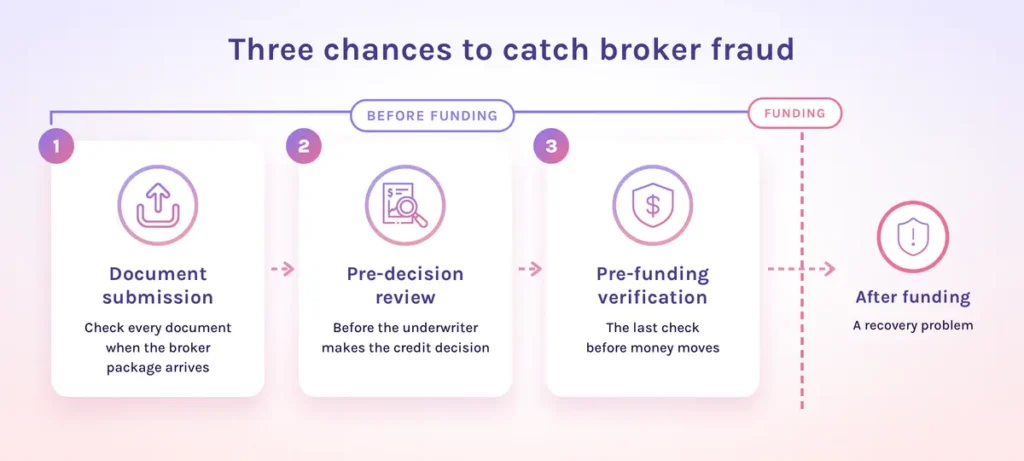
Checking at more than one moment closes more gaps. Kalamata Capital Group, a small business funder, runs document fraud checks at submission and again after contract signing.
How equipment finance fraud detection scales with volume
Manual review can’t keep pace with a full broker pipeline. Automated detection applies the same check to every document, whatever the volume. Ocrolus fraud detection scores every submitted document for authenticity before analysis begins, including the ones that look clean, and flags the patterns that show up in equipment finance: altered balances, inflated deposits and fabricated revenue.
The exposure is broad. Across 1.46 million small business applications Ocrolus processed over 90 days, 1 in 8 contained suspicious documents. The rate held steady across the period, so it reflects a baseline rather than a spike.
At Beacon Funding, Ocrolus Detect catches an average of five fraudulent deals a month. With an average deal size of $75,000, that adds up to $375,000 in fraudulent deals blocked every month. A high authenticity score lets the team move quickly, and a problem file is obvious. “It lights up like a Christmas tree,” Arida said. On cost, he is direct: “We get our return on investment when it flags just one potential fraudulent application.”
For equipment lenders that depend on broker volume, verifying every package before the credit decision turns fraud from a loss to recover into a deal to decline. See how Ocrolus detects fraud on broker-submitted documents.
Key takeaways
- Broker-submitted packages concentrate equipment finance fraud because brokers are typically paid on funded deals, documents arrive secondhand and credit teams have minutes per file.
- The three most common patterns are altered balances, fabricated deposits and inflated revenue, each designed to survive visual review.
- Fraud found after funding is a recovery problem; fraud caught at submission, pre-decision review or pre-funding verification is a prevention win.
- Across 1.46 million small business applications Ocrolus processed over 90 days, 1 in 8 contained suspicious documents.
- Beacon Funding blocks an average of $375,000 in fraudulent deals a month with Ocrolus Detect.
FAQs
What are the most common types of document fraud in equipment finance?
The most common patterns are altered bank statement balances, fabricated deposits and inflated revenue figures. Each is designed to make a business look able to carry the payment, and each is built to pass a visual review of the documents.
How can lenders tell if a bank statement has been altered?
Common signs include font changes mid-document, spacing inconsistencies, deposits the bank can’t confirm and figures that match other documents too neatly. Because these signs are small and easy to miss in a visual review at broker volume, automated authenticity scoring checks every statement before the credit decision.
When should equipment finance lenders check documents for fraud?
Lenders have three chances: at document submission, during pre-decision review and at pre-funding verification. Checks before the credit decision prevent losses, while fraud found after funding becomes a recovery problem.
How does automated document fraud detection work for equipment lenders?
Automated detection scores every submitted document for authenticity before analysis begins, including documents that look clean. Ocrolus flags signs of tampering such as altered balances, inflated deposits and fabricated revenue so underwriters know whether a file needs investigation.
What is the ROI of fraud detection for equipment finance lenders?
At Beacon Funding, an equipment financier, fraud detection earns back its cost when it flags a single fraudulent application, according to its credit manager. Ocrolus Detect catches an average of five fraudulent deals a month there, or $375,000 blocked at an average deal size of $75,000.