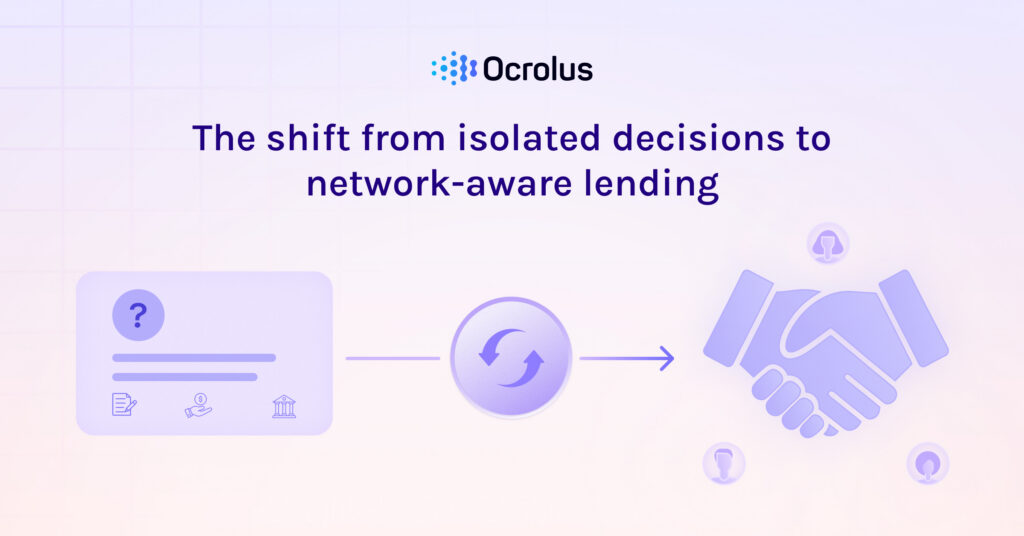
The shift from isolated decisions to network-aware lending
TL;DR: A small business can look healthy in your portfolio while quietly taking on debt elsewhere or underperforming relative to peers in the same industry. Network-aware lending gives funders a broader view of what’s happening across the market, so you can make better decisions upfront, catch problems earlier and act before performance shifts.
For years, SMB funders optimized for speed inside their own walls. They improved intake, tightened credit policy and invested in small business loan automation to process more deals with less manual work. That progress matters, but it does not solve the most common reason a “good” decision turns into a bad outcome.
Modern SMB risk moves across the market, not just inside your portfolio.
A merchant can look stable in your data while actively shopping multiple funders through brokers, embedded fintech channels or direct applications. That activity can increase leverage, accelerate stacking and change repayment behavior on a compressed timeline. When decisions are made in isolation, funders learn about these shifts late, typically after performance has already changed.
This is why the market is shifting from isolated underwriting to network-aware small business lending.
What “network-aware” means in SMB lending
Network-aware lending is not a buzzword and it is not a credit bureau. It is an operating model that combines two things:
- A trusted view of borrower capacity, grounded in cash flow and documentation
- A broader, anonymized view of the merchant in context, including how its performance compares to similar businesses and how it is behaving across the lending market over time
Network-aware lending shifts analysis from “this file in isolation” to “this business in context,” combining capacity with market behavior so risk signals are easier to spot and easier to explain.
A network helps you understand what’s happening around the merchant in the market, not just what’s in your file.
That market context is valuable because it captures behavior that no single funder can reliably see alone: application recency, frequency and velocity. Those signals help interpret intent and pressure, not just capacity.
Why this shift is happening now
Three forces are converging in SMB finance.
First, distribution is faster. Broker-driven and embedded fintech channels can move a merchant from application to offers in hours, not days.
Second, borrower behavior is more dynamic. Merchants refinance, stack and re-shop capital more frequently, especially when cash flow is volatile or seasonality hits.
Third, margins are tighter. As competition increases, the cost of underwriting blind spots rises. One surprise stacking event can erase the economic gains of multiple wins.
The result is simple: funders need higher confidence per decision, not just faster decisions.
What a lending network is and why it is valuable
A network in SMB lending is a shared visibility layer that helps funders understand borrower behavior beyond their own portfolio. It does not mean competitors see each other’s pricing or deal terms. It means funders gain market context that a single lender cannot build alone.
Think of it like this: you already know what the merchant told you and what your file shows. A network helps answer what the file cannot:
- Are they actively applying elsewhere right now?
- How often have they sought capital recently?
- Are they taking on obligations faster than their cash flow can support?
That matters because stacking and rapid re-shopping occur across lenders, not within a single book. When funders only see their slice of the story, they often find out something changed after performance shifts.
The value of a network is practical. It helps funders do three things better:
- Make cleaner decisions upfront by separating stable repeat borrowers from high-velocity applicants
- Spot trouble earlier when borrower behavior changes before delinquency shows up
- Act with more precision on renewals, collections and exposure limits based on what is happening in the broader market, not just what is happening in your portfolio
A simple example: a merchant may pay you on time while aggressively applying through multiple channels. In an isolated model, that looks fine until leverage catches up. In a network-aware model, it becomes a signal to tighten renewal posture, increase monitoring or cap exposure before a missed payment forces your hand.
Why funders should want to participate
Participation is worth it for three reasons: immediate uplift, defensive parity and compounding returns.
Immediate uplift: Even before a network reaches full scale, standardized market context can reduce manual checks and improve decision confidence, especially in edge cases that would otherwise rely on gut feel.
Defensive parity: If other funders are making network-aware decisions and you are not, you are underwriting with less context. Over time, that difference shows up in pricing discipline, renewal outcomes and loss rates.
Compounding returns: Network value increases as participation grows because the ecosystem becomes more representative of real borrower behavior. Early adopters benefit as the signal quality improves.
Beyond underwriting: where network-aware lending pays off
Underwriting is the moment you approve or decline. Portfolio performance is what happens next. Network-aware lending helps funders make stronger post-funding decisions in three areas.
Renewals: Renewals are risk decisions, not just retention plays. Network context can inform when to offer, how aggressive to be and when to apply tighter guardrails.
Collections: Collections is an information problem. Behavioral context helps teams prioritize outreach, choose the right intervention and reduce wasted touches.
Exposure management: Your true exposure is not only what you funded. It is the borrower’s total pressure across the market. Network-aware signals can support more disciplined exposure caps and monitoring cadence.
What this means for 2026
In 2026, the winners in SMB lending will not be those who are only moving fast, but those with the clearest picture of each merchant they help fund. They will know the merchants’ cash flow, their debt posture across the market and visibility into how they compare to their peers within their industry. This visibility and data consistency strengthen the network of partners: brokers, funders and analytics providers. This is what Ocrolus is delivering-network-aware lending is the future we’re making a reality.
Key takeaways
- SMB risk often moves across the market, not just inside one funder’s portfolio
- Network-aware lending pairs cash flow capacity with anonymized behavioral context like application activity
- Participation delivers immediate confidence uplift, defensive parity and compounding returns as the ecosystem grows
- The biggest portfolio benefits show up beyond underwriting in renewals, collections and exposure management
- Funders that build consistent decisions will outperform funders that stack point solutions


