Why trust is eroding in small business lending and how secure deal-sharing can fix it

TL;DR: Trust is breaking down in small business lending because today’s deal-sharing workflows were never designed for security, permissioning or traceability. Email, PDFs and unstructured document exchange expose deals to rerouting, leakage and misuse, creating prime fertile ground for backdooring. Restoring trust requires infrastructure-level change: standardized analytics, role-based access, double-opt-in sharing and automated audit trails. Secure, permissioned deal-routing is emerging as the foundation for healthier lender-broker relationships and faster, more consistent borrower outcomes.
Why trust is eroding in small business lending and how secure deal-sharing can fix it
Trust has long been the backbone of small business lending. Brokers rely on funders to evaluate deals fairly, funders rely on brokers to source qualified applicants and borrowers rely on both sides to act responsibly. Yet the industry is entering a trust recession driven by outdated workflows that make it easy for deals to leak, disappear or be rerouted without consent.
Backdooring is one of the most persistent issues. A broker submits a deal, often through email, only for someone at the lender to forward or resell the lead elsewhere. Although usually carried out by a single individual, the downstream impact destabilizes entire networks. Brokers lose faith in partners. Lenders lose visibility into deal movement. Borrowers face delays, mismatched offers or broken expectations.
Backdooring is not just a behavioral problem. It is an infrastructure problem.
The real reason backdooring persists
The core issue is that SMB lending workflows were never designed for secure, auditable collaboration. Sensitive borrower documents are still emailed as PDFs or shared through ad hoc folders. Lenders often reanalyze raw documents from scratch, creating duplicate files and expanding the surface area for leakage.
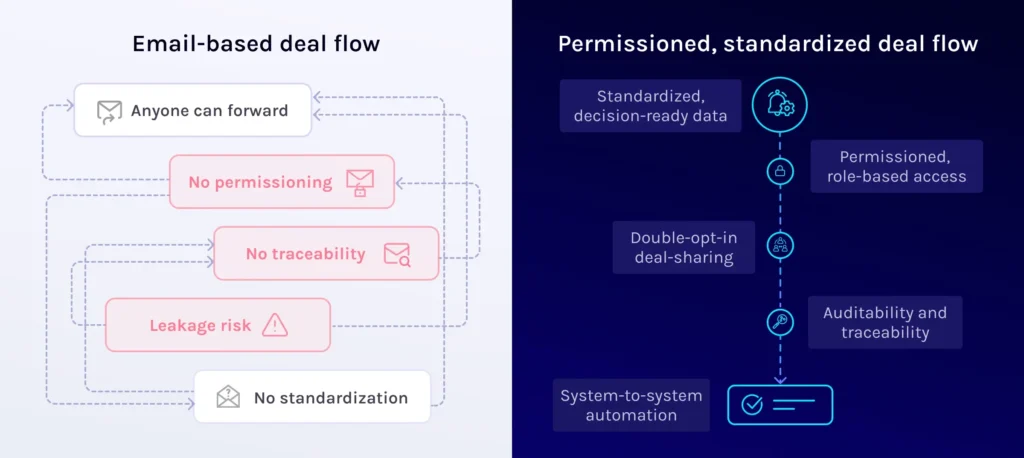
Three vulnerabilities consistently appear:
- No permissioning
Anyone with access to an inbox can forward, download or reroute deal materials. - No traceability
Email threads do not provide a verifiable audit trail. - No standardization
Each deal arrives in a different format, encouraging oversharing to avoid misunderstandings.
Across the industry, partners repeatedly ask for the same improvements: more programmatic ways to share deals and fewer manual reanalysis steps. The current model creates the ideal environment for backdooring to occur undetected.
Why traditional fixes haven’t worked
Most attempts to reduce backdooring focus on policy rather than infrastructure. NDAs, channel agreements and partner rules set expectations but do not enforce them. As long as deals move through unsecure channels, the risk persists.
Marketplace-style environments increased visibility but introduced new concerns, including channel conflict and limited transparency into routing. Point-to-point integrations help, but they rarely incorporate the level of permissioning or auditability that meaningful trust requires.
Stopping backdooring requires structural change. Secure workflows must embed trust into the process itself.
What a secure, trust-first deal-sharing model looks like
The next era of SMB lending depends on infrastructure that protects relationships, not exposes them. A trust-first model includes five essential elements:
- Permissioned, role-based access
Only authorized users and designated receiving accounts can view or handle a deal, reducing internal leakage and creating clear accountability. - Double-opt-in deal-sharing
Both sender and recipient explicitly agree to receive and evaluate a deal, eliminating silent rerouting. - Standardized, decision-ready data
Brokers should not need to overshare raw documents to be taken seriously. Standardized cash flow analytics reduce friction and minimize unnecessary data exposure. - Auditability and traceability
Every share, view and acceptance event is logged. That reduces compliance risk and strengthens partner confidence. - System-to-system automation
Email-based routing is inherently risky. API-driven workflows deliver the speed, accuracy and protection that manual processes cannot match.
These principles reflect where the ecosystem is heading and why lenders adopting secure infrastructure report improved partner relationships and faster funding cycles.
The industry is starting to adopt secure, standardized deal-sharing infrastructure, led by solutions that embed permissioning, analytics and auditability directly into underwriting workflows. Encore, powered by Ocrolus, reflects this shift. It gives brokers and lenders a permissioned, double-opt-in channel for sending deals, supported by standardized cash flow analytics and system-to-system automation. Instead of circulating PDFs through email, partners exchange decision-ready data with full traceability and visibility into every share, view and acceptance event. This architecture addresses the root causes of backdooring and data leakage while strengthening trust across the entire ecosystem.

Why the ecosystem wins when trust becomes infrastructure
Secure deal-sharing delivers immediate benefits. Brokers gain confidence that their deals will not be rerouted. Lenders receive cleaner submissions and spend less time on manual reanalysis. Borrowers experience faster decisions and more consistent offers.
The market is moving in this direction. Some platforms now offer permissioned, double-opt-in sharing integrated into underwriting workflows, supported by standardized analytics and automated audit trails. Encore exemplifies this evolution. The platform transforms messy documents into regulatory-grade decision intelligence at scale, enabling lenders to streamline underwriting and accelerate decisioning. By embedding secure, analytics-driven deal-sharing into broader workflows, the industry is beginning to close the trust gap that fuels backdoor activity.
For lenders evaluating how to rebuild confidence across their deal networks, adopting secure infrastructure is no longer optional. It is becoming a competitive requirement.
A soft path forward
Secure, permissioned, analytics-driven deal-sharing represents more than a technology upgrade. It is a structural shift in how partners collaborate and how borrowers are served.
To explore how secure, permissioned deal-sharing can strengthen your workflow, request a demo of Encore today.
Key takeaways
- Backdooring and data leakage stem from outdated infrastructure, not individual behavior
- Email-based workflows create avoidable risk across broker and lender networks
- Trust-first deal-sharing requires permissioning, double-opt-in and standardized analytics
- Secure infrastructure strengthens lender-broker relationships and accelerates funding
- The industry is moving toward API-driven sharing models that protect every party involved


