Why gig income is the hardest verification problem in consumer lending, and why it’s getting harder
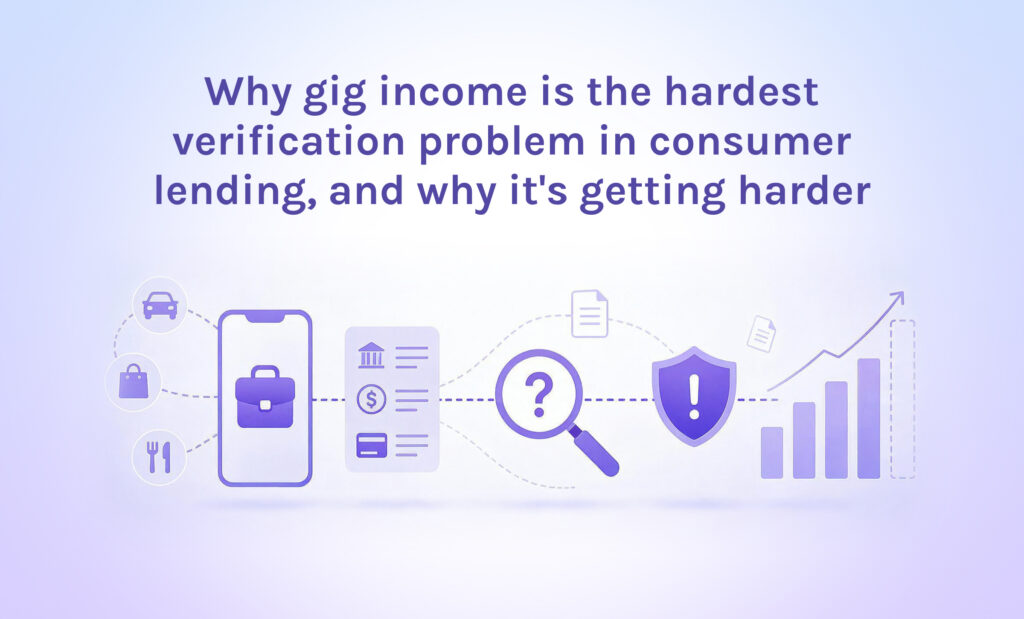
TL;DR: Traditional income verification tools (pay stubs, W-2s and employer verification) fail for gig and platform workers because they assume an employer-employee relationship that does not exist for independent contractors. The problem is growing as platform proliferation creates more complex multi-stream income profiles and as income document fraud becomes easier to execute. Bank statement analysis, which evaluates actual transaction data over time rather than point-in-time documents, gives consumer lenders a more accurate and fraud-resistant view of gig income. Ocrolus converts bank statement data into structured cash flow analytics for consumer lenders, surfacing income patterns by deposit source and producing auditable income calculations from transaction records.
A gig worker applying for a personal loan does not have a pay stub. She has weekly deposits from two delivery apps, a separate payout from a freelance platform and a 1099 she filed in April. The income is real, the cash is in her account and her payment history is clean. But the verification workflow a consumer lender built around W-2 employment has no reliable way to confirm any of it.
This is a growing segment of the consumer credit applicant pool, and the tools most lenders use were not designed for it. Gig income verification is structurally difficult, and three forces are making it harder with each passing year.
Why the standard verification toolkit fails
The standard verification stack assumes a single employer. Every tool in it (VOE, pay stub, W-2) is built to confirm a payroll relationship: someone writes a check, someone issues a tax form and someone can answer a verification call. The gig worker breaks all three at once, not because the income is insufficient but because the employer-employee relationship those tools require does not exist.
There is a further complication on the tax side. Self-employed workers file Schedule C. After legitimate deductions (mileage, equipment, platform fees), the AGI flowing through to a loan application can sit well below actual cash available for debt service. A lender working from the return sees a number that is technically accurate and practically misleading.
The toolkit was built for a specific applicant, and it works well for that applicant. For the gig worker, it produces incomplete data at best and, at worst, a distorted income picture. The income is real and recurring. Nothing in standard verification touches it.
Why the problem is getting harder
The gig applicant pool is growing. Platform work has expanded significantly over the past decade, and consumer lenders are seeing more of these applications than their verification infrastructure was built to handle. The verification gap follows each one into the queue.
Platform proliferation has made individual applicant profiles more complex. A worker earning from DoorDash, Uber Eats and a freelance marketplace simultaneously has three income streams paid on different cycles, in different amounts and from different sources. Accurately verifying any one using document-based methods is difficult. Verifying all three together to arrive at a reliable monthly income figure is not possible using pay stubs or W-2s.
The risk of income document fraud is also elevated in this segment. Platform payment statements are self-generated and carry no third-party verification. A lender cannot cross-reference them against a payroll system the way they can with an employer-issued pay stub. As the volume of gig applicants grows, so does the surface area for misrepresentation. Document-based verification has no reliable mechanism to close that gap.
What bank statement analysis makes possible
Bank statement analysis provides what document verification cannot for this population: a transaction-level view of actual income over time.
For a gig worker, that means seeing the recurring deposits from each platform, the frequency, the amounts and the consistency directly from the account where the money lands. Bank statements can be verified against the issuing institution and processed through fraud detection tools, which addresses the fraud exposure that self-generated platform documents carry.
This approach handles multi-platform income naturally. Rather than reconciling three separate income streams across three documents, a bank statement analysis aggregates deposits by source and surfaces total income relative to expenses over a rolling period. The lender sees a reliable monthly income picture without relying on documents that the applicant produced.
Ocrolus applies this model for consumer lenders: bank statement data converted into structured cash flow analytics that surface income patterns by deposit source, flag irregularities and produce an auditable income calculation from transaction data rather than point-in-time documents.
The gig workforce is large and growing. Consumer lenders whose verification workflows were built around W-2 employment are working with a model designed for a different applicant. The documentation mismatch produces errors in both directions: applicants with real income who get declined and applicants with overstated or fraudulent income who get approved.
Bank statement analysis closes that gap. The income is in the transactions. Lenders who build verification workflows around cash flow data rather than documents are better positioned to serve this population accurately and at scale.
Learn how Ocrolus helps consumer lenders verify income from bank transaction data.
Key takeaways
- Traditional income verification tools (pay stubs, W-2s, employer verification) are built for W-2 employment and fail structurally for gig and contract workers who have no employer to verify.
- Multi-platform income cannot be accurately aggregated using document-based verification designed for single-employer paychecks. This is a growing problem as more applicants earn from multiple gig apps simultaneously.
- Income document fraud is increasing in the gig segment: platform payment statements are self-generated, lack third-party verification and are straightforward to manipulate.
- Bank statement analysis provides a transaction-level view of actual income over time, handling multi-platform income naturally and without relying on applicant-produced documents.
- Consumer lenders whose verification workflows cannot accurately assess gig income risk declining creditworthy applicants and approving misrepresented ones. Both outcomes carry credit risk.
FAQs
Why does traditional income verification fail for gig workers?
Traditional income verification (pay stubs, W-2s and employer verification calls) assumes a defined employer who generates consistent, documented payroll. Gig workers are classified as independent contractors, meaning no employer verification exists. Their income is variable, spread across multiple platforms and not captured in any single document the verification workflow was designed to process.
How can consumer lenders verify gig income accurately?
Bank statement analysis is the most reliable method. By evaluating actual transaction data from the borrower’s bank account, a lender can see recurring deposits from each gig platform, assess income consistency over time and calculate a reliable monthly income figure without relying on documents the applicant produced.
What is bank statement analysis for income verification?
Bank statement analysis is the process of evaluating a borrower’s actual bank transactions to assess income, expenses and cash flow patterns. For gig workers, it captures platform deposits directly from the account, allowing lenders to verify income from multiple sources simultaneously and flag inconsistencies that might indicate fraud or misrepresentation. The same mechanics apply in mortgage contexts. Ocrolus has documented how bank statement analysis works for self-employed mortgage borrowers facing similar verification gaps.
Why is gig income verification getting harder in consumer lending?
Three factors are compounding the challenge: the gig workforce is growing, meaning more applicants have non-traditional income; platform proliferation means individual applicants increasingly have multiple simultaneous income streams; and income document fraud is rising because gig income documents are self-generated and lack third-party verification.
How does Ocrolus approach gig income verification for consumer lenders?
Ocrolus converts bank statement data into structured cash flow analytics, surfacing income patterns by deposit source and producing auditable income calculations from transaction records. This approach handles multi-platform income without relying on applicant-produced documents and can be integrated into consumer lending workflows via API or dashboard.


