The overlooked fraud risk in broker-to-funder handoffs
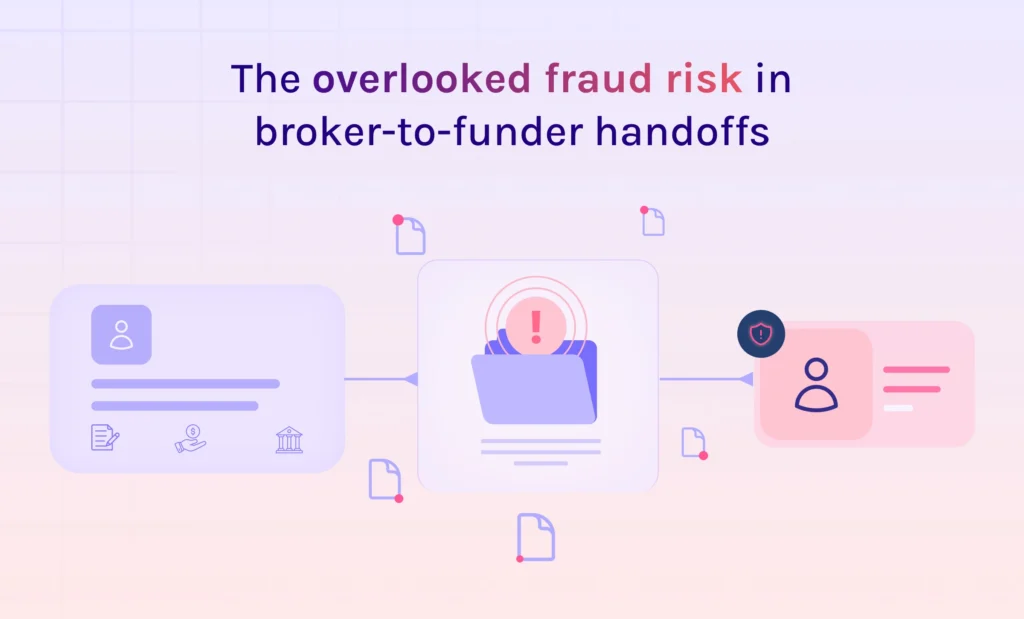
TL;DR: In small business funding, fraud exposure often starts during broker-to-funder handoffs, not underwriting. Fragmented document sharing weakens chain of custody, strips context and creates openings for tampering and inconsistencies. Secure, intelligence-driven collaboration helps funders and brokers move faster while reducing avoidable fraud risk.
Fraud in small business funding is often discussed as a bad-actor problem. Fake businesses, altered bank statements or borrowers who misrepresent financials. Those threats are real, but they are also only part of the story.
A major source of fraud exposure is more mundane. It shows up when documents and borrower data move between brokers, ISOs and funders through disconnected channels. Each handoff that relies on email threads, shared folders and re-uploaded PDFs can break the chain of custody. Context disappears. Versions drift. Review teams lose the ability to quickly answer basic questions, such as whether the file is the same one that was originally submitted.
That is why fraud risk often starts before underwriting even begins. The process creates gaps, and those gaps are where tampering and inconsistencies can hide.
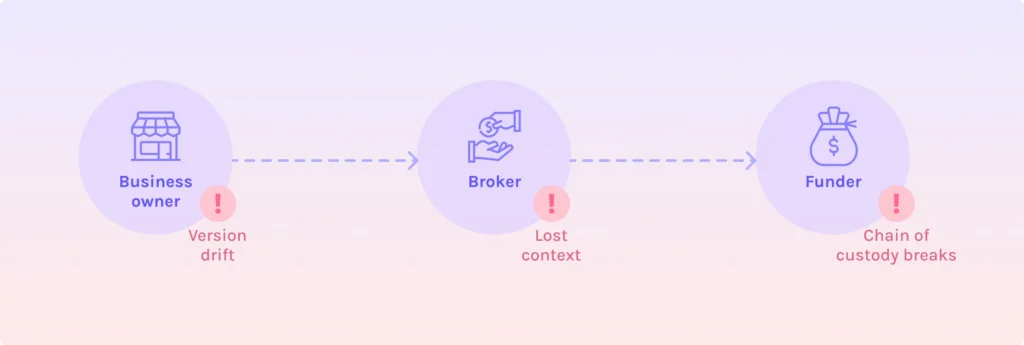
Why handoffs are the soft spot in broker-led funding
Broker-led ecosystems are built for speed. Brokers want quick answers. Funders want high-quality submissions. Borrowers want capital without delays.
The trouble is that speed is often achieved by moving files rather than by intelligence. A typical package may pass through multiple systems before it reaches a decision. In that journey, a document can be renamed, re-exported, resized, re-scanned or re-uploaded. Sometimes that is harmless operational friction. Sometimes it is a signal of something bigger.
When the chain of custody is unclear, funders are forced into a defensive workflow. Teams recheck documents that should not need to be rechecked. They ask brokers for resubmissions. Deals stall. In the worst cases, manipulation slips through because reviewers are looking at isolated PDFs instead of a connected set of signals.
This is not theoretical. LexisNexis Risk Solutions reported SMB lending fraud grew 13.6% year over year in 2023, and most lenders expected it to keep rising.
PDFs are convenient, but they are not a trust layer
PDFs preserve formatting. They do not preserve provenance.
Once a PDF is shared, it can lose metadata and context that help reviewers validate what they are seeing. A file can be replaced with a similar-looking version. Numbers can be inconsistent across submissions. A bank statement may appear aligned visually, but conflicts arise when data is compared across sources.
The point is not that every PDF is suspect. The point is that a PDF-only workflow forces fraud teams to operate late in the process, and late-stage detection is expensive.
That is why modern fraud prevention is moving upstream. It combines tampering detection with data-level fraud signals, and it routes higher-risk submissions to human review without slowing every deal.
For an overview of how this approach works across documents, data and borrower behavior, see Ocrolus’ fraud detection capabilities.
What changes when borrower intelligence is shared, not just files
Fraud prevention improves when brokers and funders collaborate around decision-ready borrower intelligence instead of passing raw documents back and forth.
In an intelligence-driven workflow, documents are still collected. The difference is that the submission carries context and validation. Tampering detection can flag altered files. Data-level signals can highlight mismatches, anomalies and inconsistencies. When risk is elevated, it can be escalated through human-in-the-loop review, and when risk is low, the deal can move.
This approach reduces the cycle of resubmits and rework that slows SMB funding. It also improves submission quality, because brokers get clearer feedback and funders get more consistent inputs.
If you want a broader view of how hidden friction impacts brokers, funders and borrowers, read The hidden friction slowing small business funding.
Encore as a secure sharing layer for trusted collaboration
To reduce fraud exposure at the handoff, the ecosystem needs a secure, efficient way to share borrower intelligence, not messy PDFs.
Encore was built to support that model. It extends the Ocrolus platform by enabling brokers and funders to share trusted, standardized borrower profiles with secure permissioning. Instead of recreating checks across multiple parties, teams collaborate around consistent borrower intelligence.
Fraud prevention that improves deal flow
Fraud prevention is not only about stopping losses. It is also about enabling more qualified deals to move quickly and confidently.
When handoffs are secure and intelligence-driven, trust improves across the broker-funder network. Brokers can deliver stronger packages. Funders can respond faster and expand partnerships with greater confidence. Borrowers get faster decisions with fewer late-stage surprises.
This is where data quality becomes a growth lever. For example, cash flow analytics can improve consistency in how borrower health is assessed, which reduces downstream rework and helps teams focus human review where it matters most. See how cash flow analytics helps expand your SMB borrower pool.
Key takeaways
- Fraud exposure in SMB funding often begins during broker-to-funder handoffs, not underwriting
- Fragmented PDF sharing weakens chain of custody and increases rework
- Intelligence-driven workflows surface tampering and inconsistencies earlier
- Human-in-the-loop review is most effective when it is triggered by risk, not used for every deal
- Secure collaboration strengthens trust, cycle times and partner ecosystems


