Scale mortgage operations with AI-driven workflow automation
TL;DR: Mortgage volume is volatile and staffing is slow to flex. AI-driven workflow automation helps lenders scale by automating data preparation across the lifecycle, improving cycle times, loan quality and borrower experience without automating credit decisions.
Mortgage lenders are being asked to do more with less, again. Volume volatility is the new normal, but the traditional playbook for scaling operations, hiring ahead of demand, is misaligned with today’s market cycle. By the time new staff are recruited, trained and fully productive, the market may have already shifted.
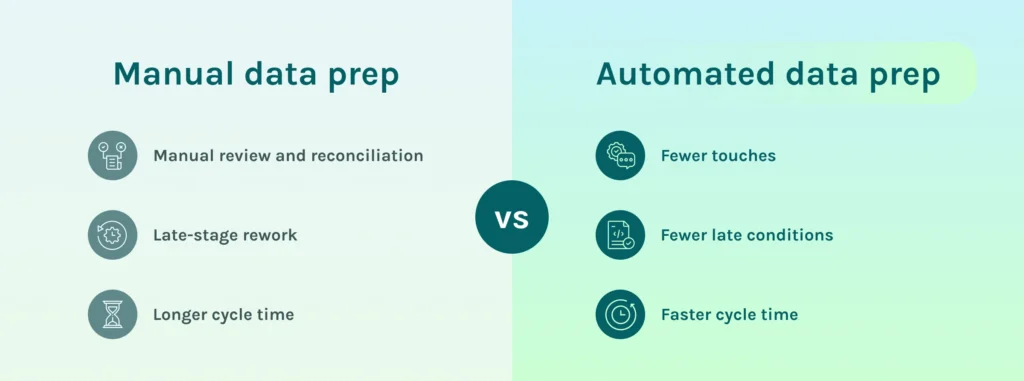
The hidden cost is not just headcount. It is the manual review, data reconciliation and late-stage rework that compound under pressure. Those friction points show up as longer cycle times, higher cost per loan and borrower frustration.
Industry forecasts underscore why flexibility matters. The Mortgage Bankers Association has projected higher single-family origination volume in 2026 versus 2025, reinforcing that lenders may need to ramp capacity quickly when demand returns.
Why doing the same things faster is not enough
Many lenders have digitized front-end processes. Documents arrive faster. Portals are cleaner. E-sign adoption is higher.
But digitization alone does not remove workflow friction. It can actually mask it by making it easier to ingest more files into the same manual downstream process.
The distinction is critical:
- Digitization moves paperwork online
- Workflow automation changes how teams prepare, validate and use information across the file
Most cycle time and quality risk do not come from credit decisions. They come from the inconsistent, labor-intensive data preparation that precedes those decisions.
The real constraint is data preparation, not underwriting expertise
Underwriters should be decision-makers, not full-time data reconciliators. Yet across the industry, high-skill teams spend significant time comparing documents to application data and loan origination system fields, recalculating income, validating assets and chasing discrepancies after the file is already moving.
That delay is expensive. Freddie Mac’s cost to originate research highlights how widely per-loan production costs can vary by operational efficiency, a reminder that workflow design is directly tied to unit economics.
What AI-driven workflow automation means for mortgage operations
Mortgage leaders are right to be skeptical of vague AI claims. In this context, AI should not be positioned as making credit decisions. It should be positioned as preparing decision-ready data earlier, with transparent calculations and a defensible audit trail.
Ocrolus is an AI-powered workflow and data analytics platform that transforms messy documents and digital data into regulatory-grade decision intelligence. Since 2016, Ocrolus has powered lenders with purpose-built AI trained on financial documents, delivered through API, dashboard and major LOS integrations. The platform blends domain-specific AI with human-in-the-loop validation so outputs are accurate, consistent and audit-ready.
In practice, AI-driven workflow automation helps lenders standardize the work that slows teams down:
- Normalizing borrower packages during intake
- Extracting and validating data from complex, unstructured documents
- Standardizing income, asset and liability calculations
- Flagging discrepancies earlier so teams can resolve issues upstream
- Reducing downstream rework across underwriting, QC and post-close
This approach supports earlier issue resolution and more consistent execution across the loan lifecycle, from intake through post-close, as outlined in From intake to post-close: streamlining the mortgage lifecycle with AI.
Scale without scaling headcount
The business goal is volume flexibility without proportional hiring. Workflow automation supports that goal in three ways.
- Earlier issue resolution: When discrepancies are identified earlier, teams reduce late-stage conditions and the operational “fire drills” that derail throughput.
- Standardization across teams: Standardized calculations and consistent evidence trails improve loan quality and strengthen alignment with secondary market expectations.
- Higher throughput per expert: When underwriters and processors spend less time preparing data, they spend more time on judgment, exceptions and documentation.
This distinction between generic tools and purpose-built platforms is critical in regulated environments, where vertical depth and governance matter, as outlined in Not an AI wrapper: what a real lending AI tech stack looks like.
Borrower experience and capital markets alignment improve together
Borrowers experience operational drag due to uncertainty: more follow-ups, unclear status, and last-minute conditions that jeopardize closing. Automation improves the borrower experience by making document requests clearer, reducing redundant touches and surfacing exceptions earlier.
At the same time, consistent analytics and documentation support investor confidence. When a lender can clearly trace calculations to source documents and explain how discrepancies were resolved, post-close quality improves and capital markets execution becomes easier.
What to look for in a mortgage AI workflow platform
Not all automation is created equal. Prioritize platforms that deliver:
- Vertical mortgage expertise, not generic document processing
- Audit-ready outputs with transparent calculations and evidence links
- Human-in-the-loop validation to protect quality at scale
- Lifecycle coverage, not a point tool that shifts work downstream
For lenders evaluating how AI fits into mortgage workflows, the Ocrolus AI Resource Center offers practical guidance to get started.

Key takeaways
- Mortgage scale is a workflow problem, not a staffing problem
- Digitization speeds intake, but automation reduces reconciliation and rework
- The right AI prepares decision-ready data and does not automate credit decisions
- Standardized, audit-ready outputs improve loan quality and capital-markets alignment
- Better borrower experience and higher pull-through start with earlier exception discovery


