From intake to post-close: streamlining the mortgage lifecycle with AI
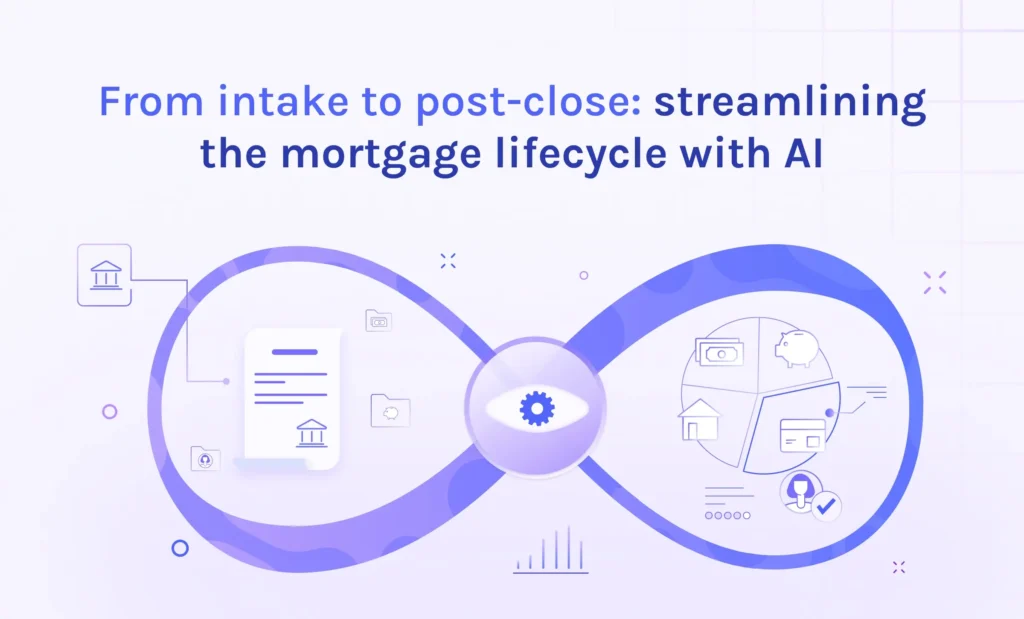
TL;DR: Mortgage operations slow down due to fragmented workflows and late checks, resulting in rework. Applying domain-specific AI across intake, document intelligence, adaptive conditions and underwriting assist turns messy uploads into reliable, auditable data, reduces unnecessary asks and speeds decisions while keeping humans in charge. Start with the highest-friction workflows, tracking stage-level KPIs such as the number of days to clear conditions and the number of touches per file. Then, expand to close and post-close processes for sustained gains in cost, speed and borrower experience.
The problem: Mortgage lending operations still run on rework
Mortgage operations slow down because work is fragmented, checks pile up late in the file and simple issues trigger over-conditioning. Point solutions at the top of the funnel help, but they rarely address the root cause. The answer is a vertical-focused AI intelligence layer trained on mortgage documents and workflows that transforms raw uploads into reliable data, guides decisions throughout the file and keeps humans in charge of the final say. When you reduce preventable rework, you reduce cycle time, pull-through and cost per loan moving in the right direction. For context on the cost curve and why small reductions matter, check out one of our most recent blogs, Mortgage manufacturing rates: bending the cost curve with AI.
Intake done right
Good outcomes start at intake. Guided uploads prevent wrong file types, unreadable scans and missing pages before a loan is created. Borrowers see more straightforward prompts and fewer follow-ups while processors avoid busywork and duplicate requests. This is not about pushing decisions into a black box. It is about reducing preventable friction and the back-and-forth that inflates the number of touches per file. When intake is correct, the file advances with fewer surprises and fewer unnecessary conditions. Teams can set simple rules of the road, such as acceptable file formats and required page counts and then measure the impact with first-pass acceptance and resubmission rates.
Document intelligence with lineage
Once documents arrive, vertical AI solutions trained on mortgage-specific patterns should extract, normalize and validate data across common and edge-case forms. Context matters as much as accuracy. Income, assets, liabilities and residency each carry nuances that generic or horizontal AI solutions miss. A strong approach links fields across documents, reconciles values and records data lineage so underwriters can see how results were derived. That audit trail becomes critical for downstream quality control and post-close reviews.
Curious about how to get your team AI-empowered? Enable them with Ocrolus’ FREE certification program.

Adaptive conditions that reduce cycles
Traditional rules engines tend to over-condition because they treat every file the same. An adaptive approach analyzes file context and user behavior to recommend only the conditions that are likely to clear a path to approval, while routine asks are generated automatically. High-impact or ambiguous items should always be routed for human judgment. The result is fewer cycles to clear conditions and a faster route to close. To see why this matters for day-to-day execution, check out our recent case study to learn how Neighborhood Loans doubled its volume for insights on how the vertical AI solution they adopted made the volume lift sustainable.
Underwriting assistance and fraud prevention
Underwriting remains a human decision. AI’s job is to consolidate “stare and compare,” triangulate values across documents and escalate valid exceptions. This involves highlighting unverified income streams, identifying mismatched account owners and flagging unsupported liabilities. It also means detecting altered documents and inconsistent data before an underwriter spends time on them. The net effect is higher leverage per underwriter and fewer downstream defects. For broader best practices on fraud vigilance, explore resources in fraud detection and prevention and monitor industry defect trends with an authoritative source like the Mortgage Bankers Association.
Need help deciding which AI solution is best for your mortgage lending operations? Use our FREE checklist to get started.
Borrower experience dividends
Clearer asks to borrowers and fewer surprises in the loan file create a smoother path to closing, ensuring that borrowers also feel the benefit of a lender’s investment in vertical AI lending tools. In a stressful process, making faster and more transparent decisions builds trust that leads to better reviews, referrals and repeat business. That is good operations practice and good revenue management for any lender.
Key takeaways
- Fragmentation drives rework, which raises cycle time and the cost per loan.
- Guided intake and document intelligence enable the creation of reliable, auditable data early.
- Adaptive conditions and underwriting assist cut unnecessary asks and surface real exceptions.
- Human judgment stays central while AI increases leverage and transparency.


