Vertical AI in mortgage: Real lender wins from document to decision

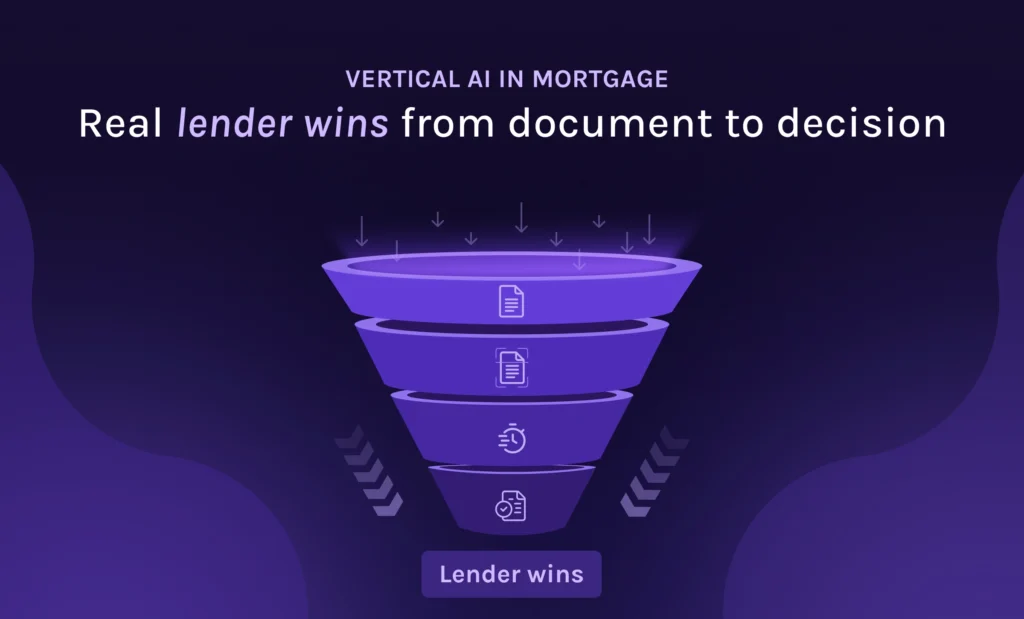
TL;DR: Vertical AI is helping mortgage lenders cut underwriting time, resolve discrepancies earlier and scale volume without new headcount. Neighborhood Loans doubled its volume, American Federal Mortgage moved decisions from hours to minutes and Compeer streamlined complex rural loan processes. The next leap is automated condition creation and management synchronized with Encompass to standardize a high-friction step and accelerate the clear-to-close process. Read the announcement on PR Newswire.
Mortgage lenders are transitioning away from generic automation to vertical AI that understands their documents, data and decision rules. The shift is practical, not theoretical. Teams are cutting underwriting time, resolving discrepancies earlier in the process and scaling throughput without adding staff. Vertical AI blends domain-specific models with workflow context, which is why it outperforms general tools for income, asset and credit analysis. Platforms like the AI-powered data and analytics platform from Ocrolus operationalize this approach across document intake, verification and conditioning so lenders can focus underwriters on valid exceptions.
Below are four real-world examples of lenders applying vertical AI to minimize touches and raise the bar in AI-powered underwriting..
Neighborhood Loans: Doubling volume through discrepancy resolution
Neighborhood Loans doubled loan volume by using vertical AI to reconcile borrower-submitted documents against application data in Encompass. Ocrolus automatically flags missing items and data conflicts, then routes clean, machine-readable results to the LOS. The outcome is fewer touches, faster files and stable quality as volume rises. In a companion initiative, the team applied the same playbook to front-end processing to reduce document requests and accelerate approvals. Read more on their borrower experience gains.
American Federal Mortgage: Minutes instead of hours for underwriting
American Federal Mortgage replaced manual verification steps with vertical AI that extracts and validates income and employment from source documents. Underwriters receive consistent, auditable outputs in minutes, not hours. The lender reports faster credit decisions, better workload balance and stronger predictability for rate locks and closing dates.
Compeer Financial: Scaling complex rural and ag mortgages
Compeer Financial supports agricultural and rural borrowers whose files often include multi-year tax returns, bank statements and nonstandard income. Vertical AI reduces repetitive data entry, normalizes formats and exposes risk signals earlier, which shortens cycle time and protects quality across a diverse portfolio.
What’s next: Automated condition creation and management
The next wave of vertical AI is moving deeper into underwriting operations. This week, Ocrolus made an announcement on automated condition creation and management at the MBA Annual Convention and Expo. Conditions are generated programmatically from document and data findings, synchronized with Encompass and tracked from identification through resolution with clear rationale and edit controls. The goal is to standardize a variable step in mortgage, eliminate rework and help lenders get to close faster.
To explore the broader AI landscape and best practices for lender adoption, visit the AI Resource Center.
Why vertical AI keeps winning in mortgage
- Domain specificity: Models are trained on mortgage documents and workflows, which improves accuracy on edge cases and reduces false conditions
- Operational alignment: Integrations with LOS systems and audit trails make outputs usable, not just accurate
- Human in the loop: Underwriters can review, override or waive with full visibility, which builds trust and speeds adoption
The lenders above show a common pattern. Start with document-to-data accuracy, add discrepancy detection and verification, then extend into automated conditioning. Each phase eliminates touches and handoffs, which is why teams see both speed and quality improve simultaneously. For organizations seeking resilience across rate and volume cycles, vertical AI is becoming the default operating model.
Key takeaways
- Vertical AI delivers faster, auditable outputs that underwriters can trust
- Lenders report shorter cycle times and fewer touches without adding staff
- Discrepancy detection and verification reduce errors and rework across the file
- Automated condition creation and management standardizes a variable step and accelerates clear to close