Where SMB lending fraud is concentrating — and why detection is falling behind
TL;DR: Analysis of hundreds of thousands of SMB lending applications processed by Ocrolus between July 2025 and February 2026 shows that fraud risk is sharply concentrated by geography and industry — anomaly incidence rates reach 22.4% in general freight trucking and exceed 11% in Pennsylvania. The dominant and fastest-growing fraud signal is unreconciled bank statement balance data, approaching 20,000 monthly incidences and roughly double year-over-year volume, reflecting a shift toward balance-level manipulation that detection models calibrated to older fraud patterns are not built to catch.
Fraud risk in SMB lending is not randomly distributed and it is not stable. New analysis of SMB lending applications processed by Ocrolus between July 2025 and February 2026 — spanning hundreds of thousands of monthly applications across more than 140,000 business entities — shows where anomaly rates are highest, how the fraud signal mix is shifting and why the tools most lenders use to catch document tampering are increasingly calibrated for the wrong threat. The pattern is clear: fraud is moving toward balance-level manipulation and template reuse, while many detection approaches remain optimized for line-item edits that characterized an earlier era. The gap between where fraud is concentrating and where detection is focused is measurable — and it is growing.
The dominant fraud signal is not what most models are built to catch
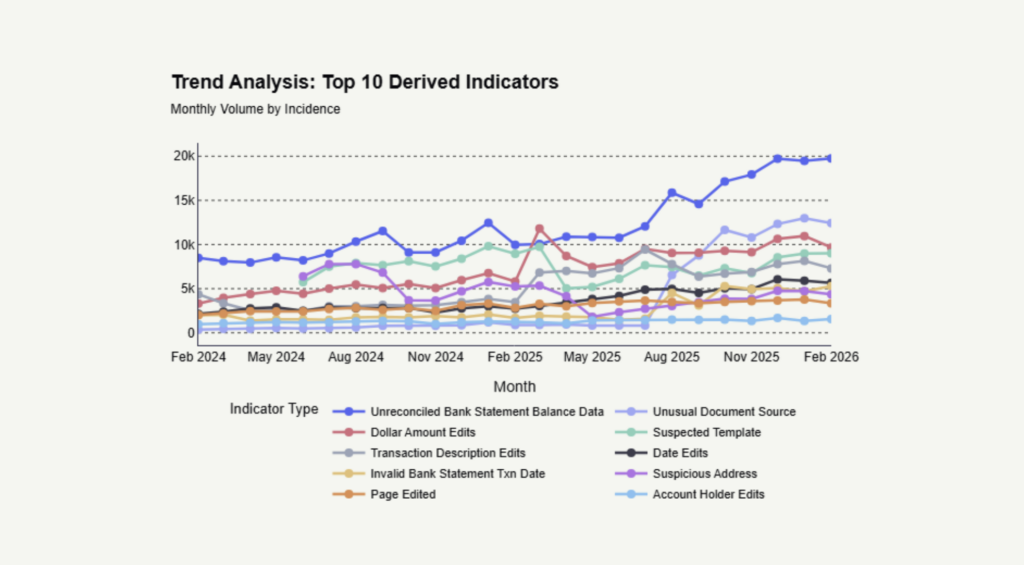
Across the top 10 fraud indicators tracked from early 2024 through February 2026, one signal stands out by volume and trajectory. Unreconciled bank statement balance data is approaching 20,000 monthly incidences as of early 2026 — roughly double the volume from a year prior. The signal indicates that a tampering method was applied that violated the internal consistency of the document at the balance level rather than the transaction line level.
That distinction matters for detection. Most lenders’ review processes were built when line-item manipulation — editing transaction descriptions, changing individual dollar amounts, modifying page-level metadata — was the dominant approach. Those methods have not disappeared, but they have plateaued. Transaction description edits and page-edited flags have remained relatively flat over the same period that balance-level manipulation has surged. Suspected template reuse, suspicious address flags and dollar amount edits are also trending upward.
The practical implication: a fraud detection model optimized for yesterday’s fraud patterns has an expanding blind spot. The full breakdown of how these signals are trending — and what that means for detection calibration — is detailed in Ocrolus’ SMB fraud research report.
Anomaly rates vary sharply by state and industry
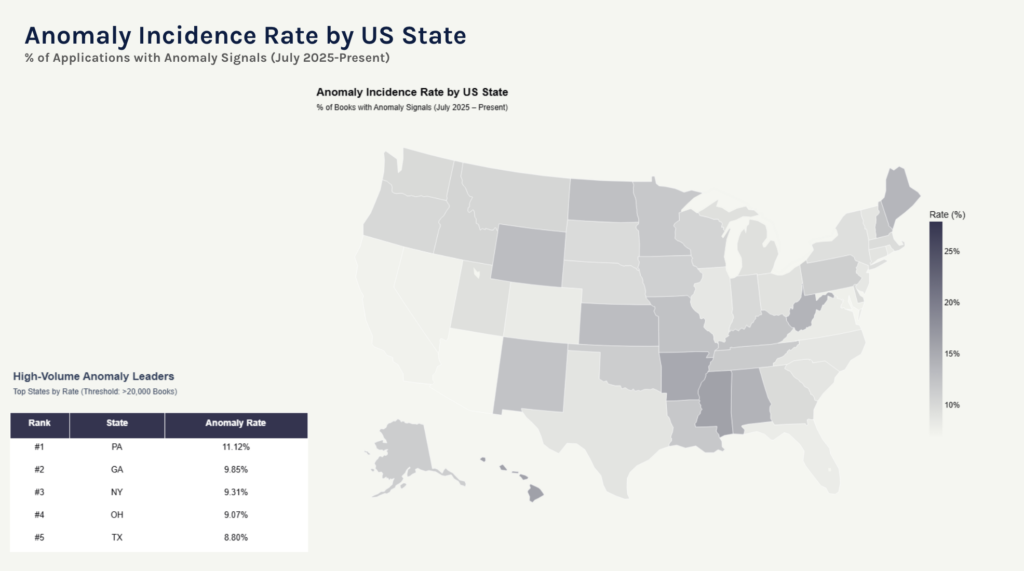
Geographic and industry concentration in the data is not subtle. Among states with more than 20,000 applications processed, Pennsylvania leads with an anomaly incidence rate of 11.12%. Georgia follows at 9.85%, New York at 9.31%, Ohio at 9.07% and Texas at 8.80%. The Southeast shows regional clustering that points to organized activity rather than random distribution.
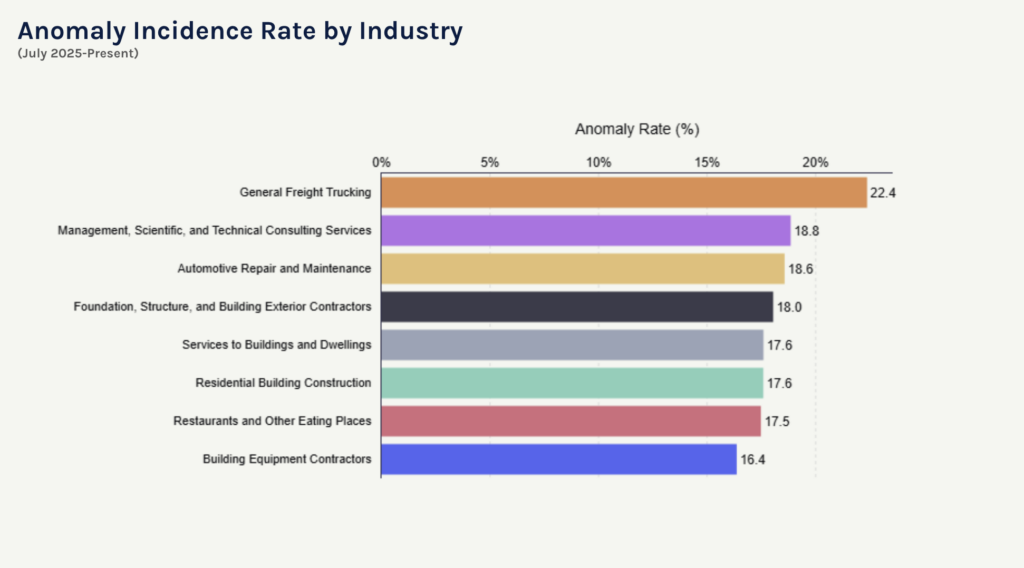
The industry spread is wider and more operationally significant. General freight trucking has an anomaly incidence rate of 22.4%. The next tier — management and technical consulting at 18.8%, automotive repair and maintenance at 18.6%, foundation and building contractors at 18.0% and restaurants at 17.5% — sits consistently above 16%. Lower-risk industries fall well below that range.
A lender applying uniform document scrutiny across all applicants is simultaneously under-reviewing high-risk applications and over-reviewing low-risk ones. That misallocation slows legitimate borrowers and misses the applications that need the most scrutiny. Industry-aware risk calibration corrects both problems at once and it starts with knowing which segments carry the most concentrated risk in the current environment.
Why point-in-time review misses the most reliable signals
More than 70% of business entities in the dataset had appeared on the Ocrolus platform previously. That figure has direct bearing on detection effectiveness. Prior application history, previously flagged document signatures and entity-level behavioral patterns are among the most reliable fraud indicators available to lenders today. They are also entirely invisible to lenders conducting point-in-time document review with no cross-application data to draw from.
Single-layer detection fails for the same reason. Internal consistency checks identify documents that do not hold up on their own terms — figures that do not reconcile, dates out of sequence, formatting inconsistent with genuine institution templates. Digital forensics surfaces signals that manual review cannot reach: metadata manipulation, injected PDF layers, font embedding anomalies and edit history. Third-party data cross-reference validates what documents claim against external sources, including tax records, industry benchmarks and business registries. Sophisticated fraud schemes are designed to pass whichever layer is weakest, which is why the Ocrolus platform for SMB lending applies all three layers to every application rather than treating them as alternatives.
Most lenders track direct fraud losses. Fewer measure what unclear document integrity costs operationally: applications slow down, reviews stack up and legitimate borrowers wait longer than they should. That friction compounds as application volume grows. Concentrating scrutiny where the risk actually is — by signal type, geography and industry — does not just improve fraud catch rates. It frees up review capacity for the cases that need it and lets clean applications move faster. The full data, including state-level and industry-level anomaly breakdowns, is in the complete SMB fraud report from Ocrolus.
Key takeaways
- Fraud risk in SMB lending is sharply concentrated — anomaly incidence rates reach 22.4% in general freight trucking and exceed 11% in Pennsylvania, with Southeast regional clustering that points to organized activity.
- The dominant and fastest-growing fraud signal is unreconciled bank statement balance data, approaching 20,000 monthly incidences by early 2026 and roughly double the volume from a year prior.
- Fraud is shifting toward balance-level manipulation and template reuse, while detection models built around line-item editing have an expanding blind spot.
- More than 70% of business entities in the dataset had been seen before — prior application history is one of the strongest fraud indicators available and is invisible to point-in-time document review.
- Effective detection requires three independent layers: internal consistency checks, digital forensics and third-party data cross-reference. Any single layer leaves exploitable gaps.
FAQs
What are the most common fraud signals in SMB lending today?
Based on Ocrolus data from July 2025 through February 2026, the dominant signal is unreconciled bank statement balance data, approaching 20,000 monthly incidences and roughly double the volume from a year prior. Suspected template reuse, suspicious address flags and dollar amount edits are also trending upward, while cruder signals like transaction description edits have plateaued.
Which industries have the highest fraud rates in small business lending?
General freight trucking leads at a 22.4% anomaly incidence rate. The next tier includes management and technical consulting (18.8%), automotive repair and maintenance (18.6%), foundation and building contractors (18.0%), residential building construction (17.6%) and restaurants (17.5%). A lender applying uniform scrutiny across all industries is misallocating review resources relative to where risk actually concentrates.
What is the difference between first-party, second-party and third-party fraud in SMB lending?
First-party fraud is the most common: the borrower directly overstates revenue, understates debt or stages transactions. Second-party fraud involves a middleman — typically a broker or referral partner — who submits or facilitates manipulated documents on the borrower’s behalf. Third-party fraud uses stolen or synthetic identities to apply in someone else’s name entirely and it is the fastest-growing of the three.
Why is manual document review not enough to catch SMB lending fraud?
Manual review is limited to what a reviewer can see on the document in isolation. It cannot surface metadata manipulation, injected PDF layers or font embedding anomalies. It cannot cross-reference entity-level behavior across prior applications. And it cannot scale to flag balance-level inconsistencies at the volume modern SMB lending pipelines require. Point-in-time review misses the fraud signals that require cross-application data and digital forensics.
How does balance-level bank statement fraud differ from line-item fraud?
Line-item fraud edits individual transactions — changing descriptions, amounts or dates — in ways that are detectable through internal consistency checks. Balance-level fraud manipulates the running balance figures themselves, which can appear internally consistent if the tampering is done carefully. Unreconciled balance data indicates a tampering method was used that violated document consistency at the balance level, a signal that detection models built around older line-item patterns are not calibrated to catch.


