The data gap slowing SMB lending automation: how shared cash flow profiles fix it
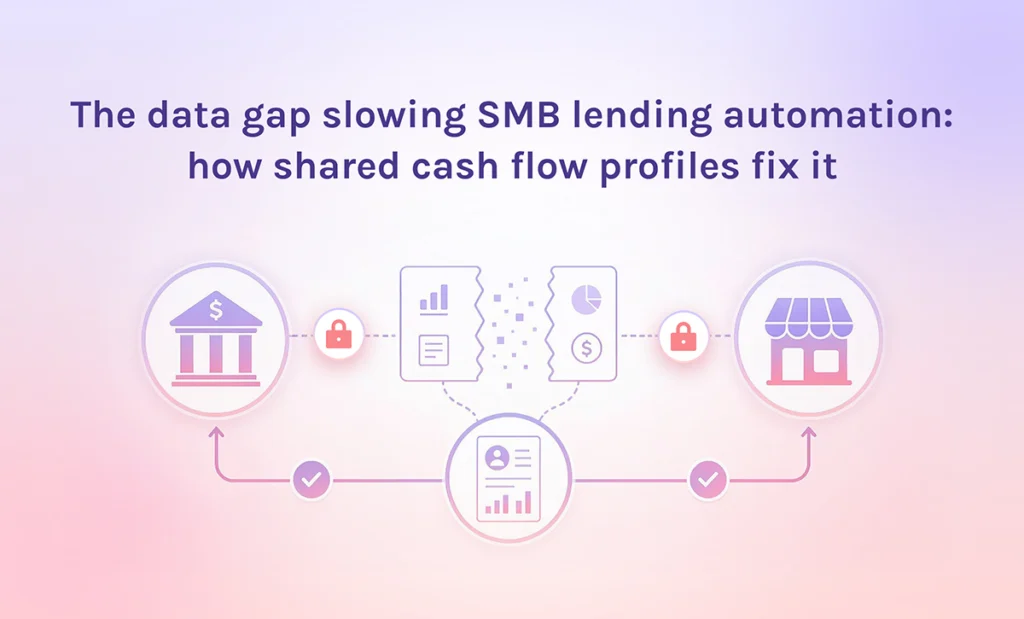
TL;DR: In small business lending, broker-funder deal friction is largely structural: each funder independently recollects and reanalyzes the same bank statements, with no mechanism to carry upstream analytical work forward. Encore, Ocrolus’s secure deal-sharing platform for SMB lenders, solves this by transferring structured cash flow profiles through double opt-in permissioning, so the analysis done at origination travels with the deal. Funders preview key cash flow metrics before committing to a review, and automated kickout rules filter out-of-appetite deals at scale without requiring manual review.
When a broker submits a deal to a funder, the funder typically starts the underwriting process from scratch. Bank statements are recollected. Cash flow analysis is rerun. Documents are indexed again by a separate ops team. This happens regardless of how much work was already done upstream, because there is no mechanism to transfer that analysis across the partnership.
The result is a funding timeline that’s longer than it needs to be, a funder operations team absorbing duplicated work and a broker who eventually sends future deals to whoever responds first. SMB lending automation has addressed many parts of the credit workflow, but the handoff between broker and funder remains largely manual and largely redundant.
Why the analytical work disappears at the handoff
The raw document is the problem. When a broker hands off a deal, what moves is the bank statement: an unprocessed file that requires analysis before it becomes useful. The funder has no way to verify whether upstream analysis was done correctly, so they rerun it. This is rational behavior from both parties and it creates a structural bottleneck regardless of the quality of the relationship between them.
The friction compounds when brokers submit to multiple funders simultaneously. Each funder runs independent analysis of the same documents, producing outputs that may differ in methodology and format. There is no consistent view of the merchant’s cash flow position and no auditable record of what was reviewed and by whom. The analysis has no portable format. Every handoff resets to zero.
The Federal Reserve’s Small Business Credit Survey consistently documents access to financing as one of the top barriers small businesses cite when seeking capital. A portion of that friction is credit-related. A significant portion is operational: time spent waiting on underwriting decisions that were already partially complete upstream.
What changes when the cash flow profile travels with the deal
A raw bank statement requires analysis before it becomes useful. A processed cash flow profile, one that has been classified, tagged and structured into revenue, expense, NSF and fintech debt categories, can be reviewed and acted on immediately. The funder does not start from scratch. The upstream analysis is portable.
Encore, Ocrolus’s secure deal-sharing platform, is built on this distinction. When a broker or funder shares a deal through Encore, what transfers is the structured cash flow profile, not the raw document. Both parties go through a double opt-in, so the data is permissioned, consistent and auditable before anyone opens it.
Before committing to a full review, the receiving funder sees a preview of key metrics: revenue, expenses, NSFs and fintech debt, via dashboard or webhook. Deals can be accepted or rejected individually or in bulk. Full audit visibility is maintained across every API and dashboard action. Funders review only the deals they are prepared to underwrite. Brokers see their submissions move faster because the analytical work they delivered is trusted rather than repeated.
Scale without adding ops
As Encore adoption grows among a funder’s partners, the volume of inbound shared deals increases with it. Manually reviewing every inbound book before deciding whether to underwrite becomes a throughput problem. A funder handling hundreds of shared deals weekly cannot maintain that review layer without a proportional increase in ops headcount.
Automated cash flow kickout rules solve this. Recipients define their credit appetite once: revenue thresholds, NSF limits, fintech debt caps, industry exclusions and state restrictions. When shared deals arrive, those parameters run automatically. Books outside the funder’s appetite are filtered before they reach the underwriting queue. No manual review is required for filtered deals.
Every inbound book is evaluated the same way, every time, whether it arrives via API or the Ocrolus SMB platform dashboard. The result is a funder who handles more inbound deal flow without additional staffing and a broker who gets faster, more consistent signals about which partners are the right fit.
The broker-funder relationship in small business finance holds real value. The context brokers carry about their merchants, including business history, seasonal patterns and the operator’s track record, is useful to funders who cannot gather it at the same scale. But that value gets buried when the technical layer requires each party to start from scratch.
When cash flow data is treated as a portable, permissioned asset, the relationship functions the way it is designed to. Decisions move faster. Funders including Fora Financial have reduced data extraction to under 15 minutes using Ocrolus and deliver loan decisions within four hours. Merchants spend less time waiting.
Explore how Encore enables secure deal sharing within the Ocrolus SMB platform.
Key takeaways
- Redundant underwriting between brokers and funders is a structural data problem rooted in the absence of any portable format for analytical work: every handoff resets the analysis to zero.
- Sharing a processed cash flow profile is materially different from sharing a raw bank statement. The former can be acted on immediately; the latter requires re-analysis regardless of what was done upstream.
- Encore’s double opt-in permissioning ensures shared cash flow data is consistent, auditable and trusted by both parties before any review begins.
- A preview of key metrics (revenue, expenses, NSFs and fintech debt) lets funders make fast accept or reject decisions before committing to a full underwriting review.
- Automated cash flow kickout rules let funders define their credit appetite once and filter inbound shared deals at scale, enabling volume growth without proportional ops increases.
FAQs
What is Encore by Ocrolus?
Encore is Ocrolus’s secure deal-sharing platform for small business lenders. It allows brokers and funders to share structured cash flow profiles with approved partners through double opt-in permissioning, so the analytical work done at origination carries forward to the receiving party rather than being repeated from scratch.
How does Encore reduce redundant underwriting in SMB lending?
Encore transfers the processed cash flow profile, not the raw bank statement. Because the data has already been classified, tagged and structured, the receiving funder can review it immediately without rerunning the analysis. Double opt-in permissioning ensures the data is consistent and auditable for both parties from the start.
What is double opt-in in the context of SMB deal sharing?
Double opt-in means both parties in a deal share must actively consent to the data transfer. In Encore, this ensures the cash flow data being shared is permissioned by both the sender and the recipient before it is made available for review, creating an auditable record of consent on both sides.
What are automated cash flow kickout rules?
Automated cash flow kickout rules let funders define their credit appetite parameters once: revenue thresholds, NSF limits, fintech debt caps, industry exclusions and state restrictions. When shared deals arrive through Encore, those rules run automatically, filtering out-of-appetite deals before they reach the underwriting queue.
How does Encore improve funding timelines for SMB brokers?
When a funder receives a deal through Encore, they work from an already-processed cash flow profile rather than recollecting and reanalyzing documents. Preview metrics allow a fast accept or reject decision before a full review begins. Automated kickout rules filter deal flow before it reaches manual review. Combined, these mechanics reduce decision time and give brokers cleaner, faster signals on fit.


