The mortgage fraud patterns that manual review misses, and what AI catches instead
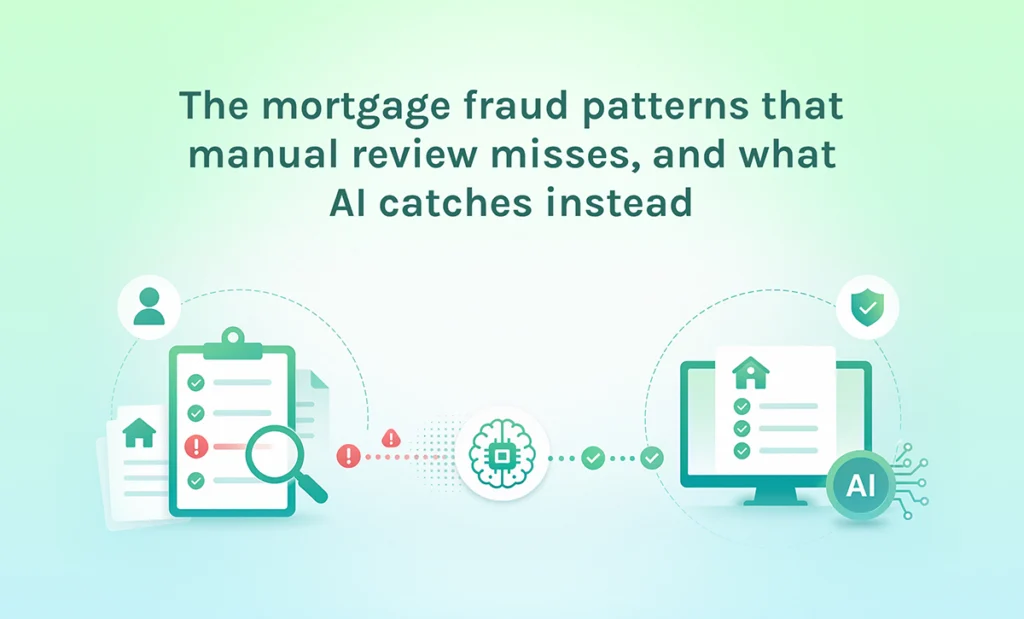
TL;DR: Mortgage document fraud has grown more sophisticated as digital editing tools make bank statement and income document manipulation increasingly accessible. Visual review was never designed to catch alterations made at the pixel and metadata level. JMAC Lending, a wholesale lender operating in 39 states, stopped nearly $2 million in fraudulent loan volume in the first months of using Ocrolus Detect by shifting from selective manual review to automated detection that runs on every file.
Digital editing tools have made financial document manipulation more accessible than at any point in the history of mortgage lending. What once required technical expertise now takes minutes. The resulting alterations are built to pass the industry’s primary fraud defense: an underwriter reviewing a file on screen, looking for something that looks off. That was never a system designed to catch alterations it cannot see. It was built for an era when fabricating a convincing financial document required meaningful effort. The tools for creating convincing forgeries are now widely available and being used at scale.
What mortgage document fraud looks like in 2026
Bank statement manipulation is one the most common forms of mortgage document fraud underwriters encounter. Borrowers alter deposit amounts, remove transactions or fabricate balances that make a file look clean on first review. At JMAC Lending, a California-based wholesale lender that originates agency, jumbo, FHA, VA and USDA products across 39 states, one case illustrated how precise these alterations have become. A borrower submitted a bank statement showing a $300,000 deposit. When JMAC’s team reverified the balance directly with the bank, the account held $1,200. The deposit had been fabricated in its entirety.
Income document fraud follows a similar pattern. Paystubs and W-2s are routinely altered to inflate income figures or fabricate employer relationships. The alterations are often minor, a changed digit or a reformatted line, designed to pass the kind of visual check an underwriter runs in the minutes available per document. Across the lending industry, 8.5% of documents exhibit high-risk fraud signals, a figure that points to a structural problem rather than isolated behavior.
Why visual review creates a coverage gap
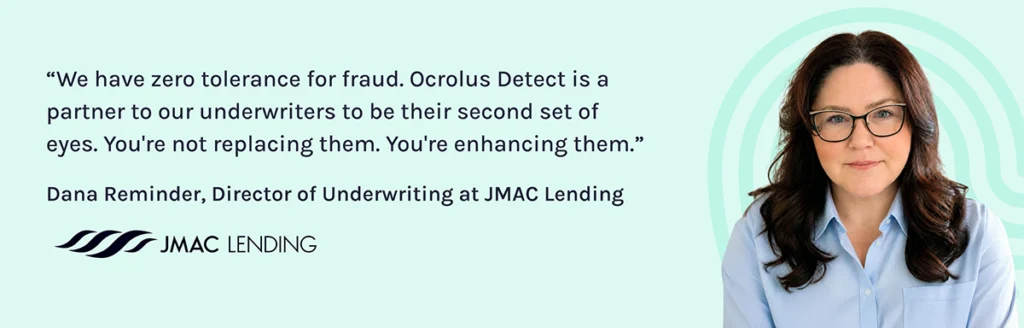
Before JMAC adopted automated fraud detection, document authentication depended on what a reviewer could spot on screen. “What it honestly came down to was the eyes of the person reviewing the file,” said Dana Reminder, Director of Underwriting at JMAC Lending. “You were really hinging it on a seasoned underwriter opening up a file, looking at a bank statement and seeing something that looked off.”
That approach has two fundamental weaknesses. The first is inconsistency: results vary from reviewer to reviewer with no shared threshold for what qualifies as a suspicious document. The second is time. A standard file required at least 15 minutes of manual authentication work — and for complex bank statement programs, hours of reconciliation by hand. At that rate, selective review is not a choice. It is the only operationally viable option. Selective review means some files never get a close look, and the files most likely to slip through are the ones prepared to do exactly that.
How AI detects what visual review cannot
The structural advantage of AI-powered mortgage fraud detection is that it operates at the signal level, not the visual level. Ocrolus Detect analyzes both the image and the available metadata when a document enters the pipeline, surfacing edits that are invisible on screen. Edits that are invisible on screen register as signals at the image and metadata level — the kind no reviewer can reliably catch by eye across a high-volume pipeline.
JMAC embedded Detect directly into its Encompass workflow, screening every submission and resubmission automatically as bank statements, paystubs and W-2s arrive. Coverage became universal rather than selective, and every reviewer works to the same standard. “The underwriter is that human in the loop that starts looking at the documentation and taking in the flags and Detect signals to truly see if something looks off,” Reminder said.
The result in the first months of use: nearly $2 million in fraudulent loan volume identified, manual document authentication eliminated and a consistent fraud threshold applied to every file regardless of which underwriter is reviewing it.
The stakes in mortgage fraud extend beyond individual loans. Investor eligibility and agency designations depend on maintaining clean origination records. “It’s your reputation, it’s your designations; if it’s your FHA loans, it keeps you off of being on the neighborhood watch,” Reminder said. “We’re not putting ourselves at risk of being disqualified from any of our investors.” Fraud detection built on visual review was always a temporary solution. The alterations it misses are not random. They are engineered to pass exactly that kind of check.
Key takeaways
- Mortgage document fraud has grown more sophisticated as digital editing tools make bank statement and income document alteration increasingly accessible. The resulting alterations are built to pass visual inspection.
- Visual review produces inconsistent results because there is no shared threshold for what constitutes a suspicious document, and results vary from reviewer to reviewer with no uniform escalation path.
- Manual document authentication costs 15 to 60 minutes per file, making universal coverage operationally impossible. Selective review means the files most likely to contain fraud are also the ones most likely to receive less scrutiny.
- AI-powered fraud detection operates at the signal level, analyzing image data and file metadata to surface alterations that are invisible on screen and impossible to catch through visual review at scale.
- JMAC Lending stopped nearly $2 million in fraudulent loan volume in the first months of automated detection, with Detect running on 100% of files inside its Encompass workflow and a single consistent fraud threshold applied across the entire underwriting team.
FAQs
What types of document fraud are most common in mortgage lending?
Bank statement manipulation is the most prevalent form of mortgage document fraud. Common patterns include fabricated deposit entries, altered account balances and removed transactions designed to improve a borrower’s apparent financial profile. Income document fraud is also widespread: paystubs and W-2s are routinely altered to inflate income figures or fabricate employer relationships. Both types are increasingly difficult to detect through visual review because the alterations are built to look legitimate on screen.
Why can’t manual review reliably catch mortgage document fraud?
Manual review has two structural limitations. First, results are inconsistent: without a defined threshold for what constitutes a suspicious document, different reviewers make different judgments on the same file. Second, time constraints force selective rather than universal coverage. A standard mortgage file takes at least 15 minutes to authenticate manually, and complex bank statement programs can take hours to reconcile by hand. At that volume, some files never receive a thorough look, and fraudulent documents are often engineered to pass cursory review.
How does AI detect altered bank statements and income documents?
AI-powered fraud detection like Ocrolus Detect analyzes both the image content and the available file metadata for every document that enters the pipeline. Edits that are invisible on screen leave signals at the image and metadata level that visual review cannot detect. The system flags suspicious documents automatically, allowing underwriters to focus their review on files with confirmed signals rather than screening every document from scratch. Running on every submission and resubmission, it provides universal coverage that manual review cannot match.
What are the consequences of mortgage fraud for lenders beyond the individual loan?
The consequences extend to investor eligibility and agency designations. Lenders originating fraudulent loans risk losing program access, being removed from investor relationships and jeopardizing FHA designations. For wholesale lenders in particular, maintaining clean origination records is a prerequisite for the program access and investor relationships the business depends on.


