Instant insights in asset review: 4 signals every lender should surface
TL;DR: Asset review slows mortgage lending not because data is missing, but because it’s buried. In our latest Ocrolus Live Session, experts shared how underwriters can instantly surface four high-impact signals: —BNPL, wage garnishments, large deposits and undisclosed debts—to improve DTI/ATR accuracy, cut SLAs and reduce borrower friction. The takeaway: automation surfaces the data, human judgment drives the decision.
Lenders know asset review is one of the most time-consuming parts of mortgage underwriting. The problem isn’t that the data doesn’t exist; valuable insights are buried across pages of statements. In our most recent Ocrolus Live Session, industry experts explored how mortgage underwriters can instantly surface the right asset insights, streamline workflows and reduce compliance risk.
The fireside chat highlighted how automation reshapes asset review by shifting focus from manual searching to meaningful analysis. Here are the top takeaways.
Watch the replay
The real pain point: buried insights slow decisioning
Underwriters spend hours manually hunting for anomalies—large deposits, wage garnishments, buy now, pay later (BNPL) obligations—that can materially affect debt-to-income (DTI) and ability to repay (ATR) calculation, a focus outlined in the Fannie Mae Selling Guide.
This time sink drives longer service-level agreements (SLAs), more conditions and higher borrower friction. The message was clear: the problem isn’t missing data, it’s buried data.
4 high-value signals mortgage lenders should surface instantly
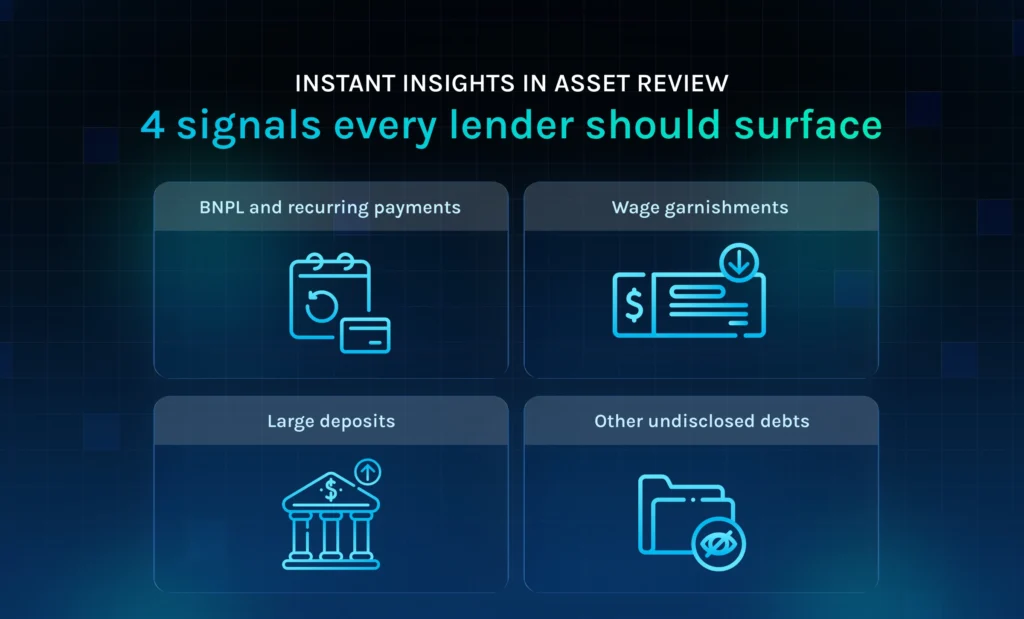
The session identified four asset review signals that matter most:
- BNPL and recurring payments: Undisclosed debts hidden as consumer transactions can distort true repayment capacity.
- Wage garnishments: These directly reduce disposable income and must be factored into income stability.
- Large deposits: Flagging and documenting these early reduces LOEs and audit issues.
- Other undisclosed debts: Patterns of recurring obligations not listed on applications can materially change DTI calculations.
By surfacing these signals automatically, lenders can shorten condition clearance and strengthen compliance posture.
The impact on DTI and ATR
Not all insights carry equal weight. The panel emphasized that surfaced anomalies must be directly related to underwriting impact, which are central to the Ability-to-Repay/Qualified Mortgage rule.
Focusing on “move-the-needle” signals helps lenders avoid drowning in noise. For example:
- A recurring $200 BNPL repayment can shift DTI enough to push a borrower outside qualifying thresholds.
- Large, unexplained deposits can raise red flags during audits, increasing buyback risk.
The bottom line: surfaced insights should support accurate decisioning and reduce repurchase exposure.
How workflows evolve with surfaced insights
Operationally, asset review automation eliminates the “hunt” phase. Instead of sifting through pages of statements, mortgage underwriters receive surfaced, contextualized data upfront.
This shift allows teams to:
- Focus on evaluating borrower risk, not searching for anomalies
- Reduce conditions and letters of explanation (LOEs)
- Clear loans faster, improving SLA adherence and borrower experience
Human-in-the-loop judgment remains critical, but automation ensures judgment is applied to high-value analysis instead of data entry.
Practical steps for mortgage lenders
The Live Session closed with guidance on how lenders can operationalize surfaced insights:
- Re-prioritize workflows: Make surfaced anomalies the first review step.
- Reduce LOEs: Flagging deposits and debts early eliminates unnecessary back-and-forth with borrowers.
- Balance automation + human review: Trust surfaced data, but maintain judgment for nuanced cases.
Together, these changes can deliver faster decisioning, stronger compliance and less borrower friction.

The future of asset review
The discussion underscored that asset review doesn’t need to be a bottleneck. By instantly surfacing the right signals, lenders can strengthen compliance, cut SLAs and improve borrower experience without sacrificing judgment.
Ocrolus’ mortgage solution enables lenders to detect BNPL, wage garnishments, large deposits and other anomalies in seconds, allowing underwriters to make faster, more confident decisions.
For lenders seeking to stay competitive in today’s high-stakes market, this blend of automation and human expertise is no longer optional. It’s mission-critical.
Neighborhood Loans reduces processing time by 90% with Ocrolus AI
Key takeaways
- Asset review bottlenecks stem from buried, not missing, data
- Four signals matter most: BNPL, wage garnishments, large deposits and undisclosed debts
- Surfacing these insights strengthens DTI/ATR accuracy and reduces buyback risk
- Automation shifts underwriters from “search mode” to “analysis mode”
- Balancing surfaced insights with human judgment creates faster, more reliable decisions


