What a guideline-cited condition looks like, and why underwriters trust it

TL;DR: A guideline-cited condition shows the underwriter the borrower-specific issue, the Fannie Mae or Freddie Mac guide section behind it and the supporting document, so the condition can be checked before the underwriter decides. Ocrolus Inspect generates these automated conditions for conventional loans from borrower documents, 1003 data, AUS findings and Selling Guide requirements, and the underwriter reviews and decides on each one. This post walks through a real Inspect condition for a pay stub dated outside Fannie Mae’s 30-day window, field by field.
“It’s doing a really good job of capturing data, saying, this deposit for $6,000 exceeds the threshold that AUS requires,” said Kelly Haney, Chief Strategy Officer and Head of Capital Markets and Technology at Mortgage Financial Services, describing the conditions Ocrolus Inspect writes for his team. “My underwriting manager was really excited about it. It was very detailed and to the point.”
An underwriting manager getting excited about a condition says a lot about how conditions usually arrive. They’re written by hand, tracked by LOS tools that don’t write them or generated by platforms that decide without the underwriter. A guideline-cited condition shows the underwriter three things: the borrower-specific issue, the guideline behind it and the document it came from. Here’s what that looks like on a real condition Ocrolus Inspect generated for a pay stub, and why underwriters trust it.
Why pay stub dates turn into conditions
Fannie Mae’s standards for employment and income documentation require the most recent pay stub to be dated no earlier than 30 days before the initial loan application date and to include all year-to-date earnings. For base pay on a DU loan, Fannie Mae accepts a completed Form 1005 or the borrower’s recent pay stub and W-2s covering the most recent one-year period.
The check itself is simple: compare two dates. Finding the gap takes time. In a file with several pay stubs, someone has to identify the most recent one, compare its date with the application date and catch the problem before underwriting does. When that happens late, the result is a late condition and another request to the borrower.
Surfacing problems before underwriting is what Inspect insights are built for. At Legacy Mutual Mortgage, Implementation Coordinator Christina Hawkins said Inspect is “alerting the upfront team of potential needs instead of underwriting having to condition for an LOE, an address discrepancy or a large deposit.” Automated conditions take the next step and write the condition itself.
What a guideline-cited condition looks like
Ocrolus Inspect generates automated conditions from borrower documents, 1003 application data, AUS findings and Fannie Mae and Freddie Mac guide requirements. Here’s one from the Inspect condition detail view, shown with sample borrower data:
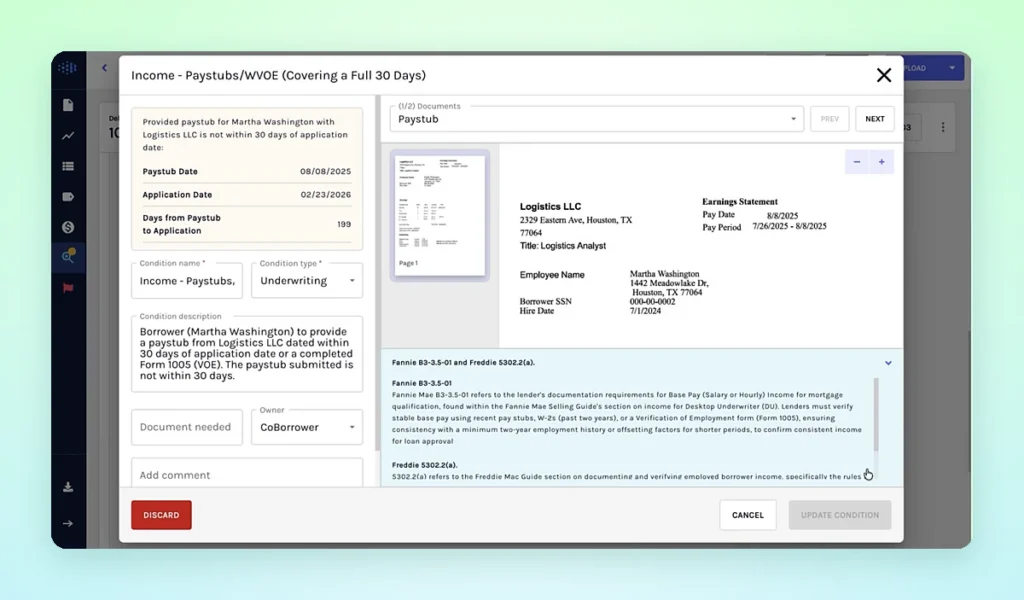
An automated condition in Ocrolus Inspect.
- Condition name: Income – Paystubs/WVOE (Covering a Full 30 Days)
- Condition type: Underwriting
- Description: “Borrower (Martha Washington) to provide a paystub from Logistics LLC dated within 30 days of application date or a completed Form 1005 (VOE). The paystub submitted is not within 30 days.”
- The evidence: A pay stub dated Aug. 8, 2025, against an application date of Feb. 23, 2026, 199 days apart
- Guideline reference: Fannie B3-3.5-01 and Freddie 5302.2(a), each with a plain-language summary of what the section requires
- Supporting documents: The pay stub, open beside the condition
The Mortgage Financial Services customer story describes these as conditions “written the way an underwriter would write them.” This one names the borrower, the employer and the gap. It also gives two acceptable fixes: a current pay stub or a completed Form 1005. The processor knows exactly what to ask for, and the borrower knows exactly what to send.
Why underwriters trust it
Underwriters trust what they can check, and every part of this condition can be checked.
The rule is cited. The condition names the Fannie Mae and Freddie Mac sections behind it and summarizes each, so the underwriter can confirm the requirement before deciding.
The math is shown. The pay stub date, the application date and the days between them sit at the top of the condition, with the pay stub beside it.
It reads like the lender’s own work. For Encompass lenders, condition names follow the lender’s own condition templates, so conditions look the way the team already writes them.
The underwriter decides. The underwriter can update a condition or discard one that doesn’t apply. When new documents arrive, Inspect checks them against open conditions, and the underwriter makes the call.
What changes for the file
Conditions are written before the file reaches underwriting. The borrower gets one consolidated request for asset, credit and income conditions instead of a trickle. Condition status stays in sync with Encompass and MeridianLink. Lenders are cutting median time from complete application to final approval from 19 to 15.5 days, about 20% faster, after adopting Ocrolus Inspect. Automated conditions cover conventional loans today.
To see conditions generated from start to finish, watch the Product Pulse on Inspect with condition creation for Encompass or explore Ocrolus Inspect. Current Ocrolus customers can ask their account manager about adding automated conditions.
Key takeaways
- A guideline-cited condition shows the borrower-specific issue, the guide section behind it and the supporting document.
- Fannie Mae requires the most recent pay stub to be dated no earlier than 30 days before the initial loan application date whenever a pay stub documents income.
- Ocrolus Inspect generates automated conditions from borrower documents, 1003 data, AUS findings and Fannie Mae and Freddie Mac guide requirements, with names mapped to the lender’s Encompass templates.
- Underwriters trust these conditions because the rule, the evidence and the final decision all stay in front of them.
- Automated conditions cover conventional loans in asset, credit and income categories, with status sync in Encompass and MeridianLink.
FAQs
What is a guideline-cited condition in mortgage underwriting?
A guideline-cited condition is a mortgage condition that cites the specific Fannie Mae or Freddie Mac guide section behind it. It also carries a borrower-specific description and the supporting document, so the underwriter can check the rule and the evidence before deciding.
How recent does a pay stub need to be for a Fannie Mae loan?
Fannie Mae requires the most recent pay stub to be dated no earlier than 30 days before the initial loan application date, and it must include all year-to-date earnings. For base pay on a DU loan, Fannie Mae accepts a completed Form 1005 or the borrower’s recent pay stub and W-2s covering the most recent one-year period.
How does Ocrolus generate automated mortgage conditions?
Ocrolus Inspect generates conditions from borrower documents, 1003 application data, AUS findings and Fannie Mae and Freddie Mac guide requirements. Each condition carries a name mapped to the lender’s Encompass templates, a borrower-specific description, a guideline reference and the supporting document. Conditions export to Encompass or MeridianLink with status sync.
Do automated conditions take decisions away from underwriters?
No. The underwriter reviews each condition, updates or discards it as needed and makes the call when new documents arrive. Ocrolus writes the condition, and the underwriter decides.
Which loans do Ocrolus automated conditions cover?
Automated conditions cover conventional loans today, across asset, credit and income condition categories. They work in Encompass and MeridianLink, and lenders on other LOS can use them on the Ocrolus dashboard.