How to cut the time and cost of bank statement analysis in forensic accounting
TL;DR: Bank statement analysis is one of the biggest drivers of time and cost in forensic accounting engagements, because more accounts and more years mean more transactions to convert, trace and reconcile. Firms can automate the conversion of bank statements into structured data and keep human judgment for payee identification, classification and expert findings. Rocky Mountain Advisory, a Salt Lake City forensic accounting firm, estimated that Ocrolus cost about 20% of what it previously spent on manual data entry.
When a fraud investigation, divorce or bankruptcy matter turns on where the money went, the answer is usually in the bank statements. Getting it out is slow. Statements arrive as months or years of PDFs, some of them scanned, and every transaction has to land in a spreadsheet before anyone can trace a dollar. Forensic engagements are typically billed by the hour, and BPM, a national accounting firm, names the volume and organization of records as one of the main things that set an engagement’s cost. More accounts and more years mean more hours. For a firm that wants to cut the time and cost of bank statement analysis, the conversion step is the place to start.
Where the hours go in bank statement analysis
Bank records carry weight because the books often can’t be trusted. If the general ledger is incomplete, or was kept by the person under investigation, the bank’s record of what actually cleared is the stronger evidence.
Volume is the catch. Rocky Mountain Advisory (RMA), now Marshall & Stevens, handles forensic accounting, bankruptcy and dispute work. They said manual entry took “somewhere between a few days to weeks or months” depending on how many documents a case involved. In an hourly engagement, that time comes out of the budget before any analysis begins. RMA’s published story also notes that its manual approach carried significant costs for clients.
Accuracy suffers, too. Keying thousands of dates and amounts is tedious work, and tired people make typos. A wrong figure in the underlying data can surface in an expert report, which is exactly where opposing counsel will look for it.
And the work tends to land on the wrong people. Data entry has traditionally gone to interns and junior staff, the same people a firm is trying to turn into analysts. RMA ran into this while also dealing with the broader difficulty of hiring and keeping qualified accounting staff.
What to automate in bank statement analysis, and what to leave alone
Turning a statement into rows in Excel or a database takes no professional judgment. It’s the part of the job software should handle. Ocrolus’ document understanding for bank statements converts statements into structured data, so analysts open a usable file instead of a folder of PDFs.
What comes after that still needs a person. Say a statement shows check 2047 clearing for $4,800. The statement won’t say who cashed it, so someone has to pull the check image or the supporting records. Deciding whether a transfer was a personal expense, a diverted payment or a legitimate business cost depends on what the team knows about the case. The summaries, patterns and conclusions in the expert report are what the client is paying for in the first place.
Software can do the typing. The engagement team keeps the judgment calls and the opinion.
What happened at one forensic firm
RMA works for legal, corporate and public sector clients on investigations that follow cash in and out of accounts. It used to rely on manual entry, with interns and entry-level hires doing much of it.
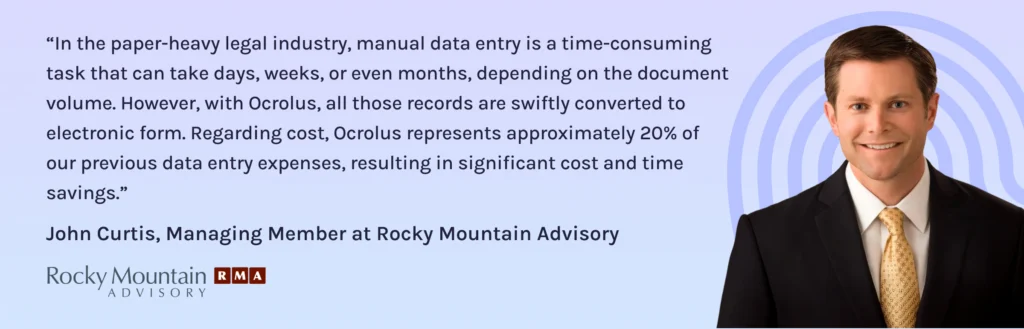
Once the firm started using Ocrolus to convert bank statements and other paper records into electronic formats, its team could go straight to the analysis. “Ocrolus will convert everything to a general format, essentially Microsoft Excel or a database where we can query, summarize and find patterns,” said John Curtis, a Managing Member at RMA.
Curtis estimated that Ocrolus cost about 20% of what the firm had been spending on manual data entry, an 80% reduction. Staff time moved to analysis and casework, and RMA went on to recommend Ocrolus to the State of Utah’s Attorney General’s office. The Rocky Mountain Advisory customer story has the full account.
Start with the conversion step
Automating conversion frees up hours for tracing and for the report, and it gets junior staff to analytical work sooner. It also means the numbers behind an expert opinion start from a cleaner source. For firms where bank statements show up in most engagements, that adds up quickly. A simple way to test it is on a single matter: run one case’s statements through automated conversion, then compare the hours against a similar case your team keyed by hand. See how Ocrolus supports legal and forensic accounting work.
Key takeaways
- More accounts and more years mean more statements to key, which makes bank statement analysis one of the biggest drivers of forensic engagement time and cost.
- Manual conversion consumes hourly budget and junior staff time and introduces errors that can carry into an expert report.
- Converting statements into Excel or a database is mechanical and can be automated; payee identification, classification and findings require human judgment.
- Rocky Mountain Advisory estimated that Ocrolus cost about 20% of its previous manual data entry expenses, an 80% reduction.
FAQs
How do forensic accountants analyze bank statements?
Forensic accountants convert bank and credit card statements into structured data, then summarize transactions by payee and category, add classifications based on supporting documents and look for patterns that show where money came from and where it went. The results support findings in an investigation or an expert report.
What drives the cost of a forensic accounting engagement?
Scope drives most of the cost, including the volume and organization of records, the number of accounts and the number of years under review. Most forensic engagements are billed hourly, so work that scales with record volume, such as bank statement analysis, has a direct effect on the total.
Can bank statement analysis be automated for forensic accounting?
The conversion step can. Document automation platforms such as Ocrolus convert bank statements into structured data that can be exported to Excel or a database. Analysts then review, classify and analyze the transactions instead of keying them by hand.
How much can a forensic accounting firm save by automating data entry?
Results vary by firm and volume. Rocky Mountain Advisory, a Salt Lake City forensic accounting firm, estimated that Ocrolus accounted for only 20% of the expenses it previously incurred on manual data entry.


