How automating conditions helps mortgage lenders reduce manual underwriting work

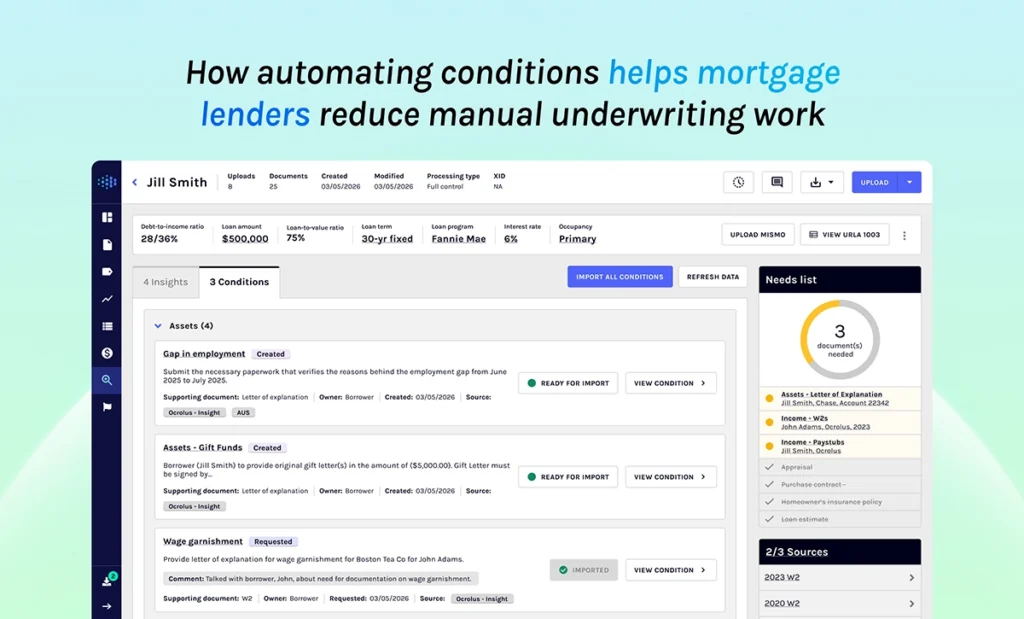
TL;DR: Mortgage underwriters have long managed conditions through a manual mix of document review, guideline interpretation and cross-system follow-up. Ocrolus’ automated conditioning capabilities help lenders generate selling-guide-aligned conditions from borrower asset, income and credit data alongside AUS findings, automatically match incoming documents and manage the full condition lifecycle in one workspace with Encompass sync. The result is faster, more consistent underwriting and a smoother path to clear-to-close.
Conditioning has remained one of mortgage underwriting’s biggest manual bottlenecks
Conditioning has historically been one of the most labor-intensive and error-prone steps in mortgage origination. Underwriters must interpret borrower documents, reference guidelines and manually author conditions, then track supporting documents and updates across multiple systems. As compliance requirements become more complex, that back-and-forth can add days to cycle times, introduce costly errors and erode the borrowers’ experience at a critical point in the loan journey.
That is the problem that Ocrolus is addressing with automated conditioning, a new capability announced at this year’s ICE Experience show as generally available on April 1. The solution is designed to help mortgage lenders generate, track and accelerate condition resolution within a single unified workspace, reducing manual underwriting work without removing underwriter oversight.
From manual authoring to a deterministic, AI-native workflow
Traditional conditioning slows teams down because it requires underwriters to move between AUS findings, investor guidelines, borrower documents and LOS workflows to manually write and manage conditions. That process is inherently time-consuming, and it can create inconsistency when conditions are authored without full context.
Ocrolus takes a different approach. Our conditions engine was built from the ground up as an AI-native product rather than bolted onto a legacy workflow. It is deterministic by design, grounded in selling guide requirements and borrower data, and built to adapt over time to each lender’s underwriting patterns.
Lenders can analyze borrower asset, income and credit data alongside AUS findings to automatically generate selling-guide-aligned conditions. That matters because conditions created without full borrower context can increase compliance risk and lead to investor pushback downstream. By grounding condition generation in complete borrower data, Ocrolus is positioning conditions as a more consistent and more defensible part of underwriting.
Ocrolus’ ability to automate conditions also fits into a broader mortgage automation strategy. As an AI-powered workflow and data analytics platform, Ocrolus already helps lenders streamline document classification, indexing, income analysis, asset analysis and fraud detection across critical underwriting workflows. Conditioning is a natural extension of that foundation for mortgage lenders. Instead of treating conditions as a disconnected downstream task, lenders can manage them as part of a more connected underwriting process built on accurate, complete borrower data. For mortgage teams focused on reducing rework and improving consistency, that broader platform story is what makes automated conditioning more than a standalone feature.
Why full lifecycle management matters
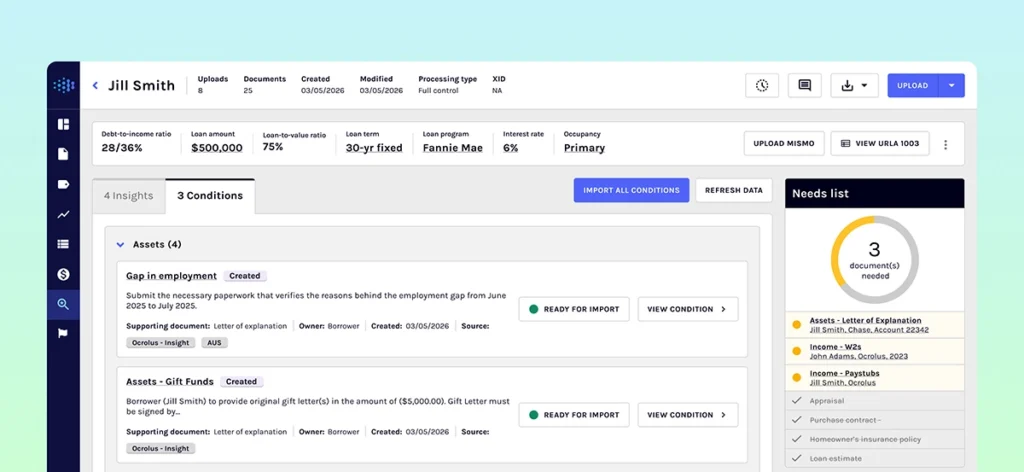
One of the biggest operational challenges in conditioning is fragmentation. Conditions often live in one system while documents arrive in another, leaving underwriters and processors to manually reconcile the two. Ocrolus’ automated conditioning is not a single-point feature, but a full lifecycle workflow that brings condition oversight into one place.
Conditions and document placeholders sync directly into Encompass. As new documents arrive, they are automatically matched to the appropriate condition. Underwriters still maintain complete control, with the ability to review, edit and import conditions without toggling between systems. The goal is not to replace judgment. It is to remove the administrative burden that slows underwriting teams down and forces them to spend too much time chasing paperwork across disconnected tools.
That single-workspace model is one of the most important parts of the launch. Mortgage teams do not need another disconnected tool. They need a way to manage the chain from condition generation through condition resolution in a process that is auditable, scalable and realistic for day-to-day underwriting operations.
Built around real underwriting workflows
We’ve developed these capabilities using feedback from mortgage customers including Mortgage, American Federal Mortgage, Neighborhood Loans, USA Mortgage and Zillow. That is an important point because conditioning is one of those workflows where practical usability matters as much as technical capability.
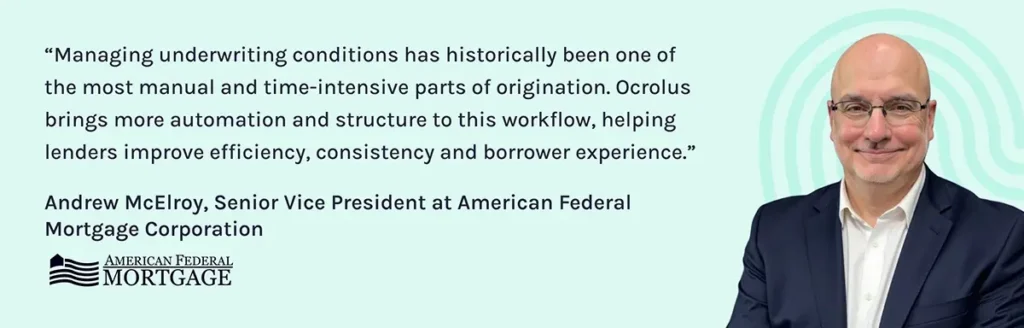
American Federal Mortgage’s Andrew McElroy described underwriting conditions as one of the most manual and time-intensive parts of origination and said Ocrolus brings more automation and structure to the process, helping lenders improve efficiency, consistency and borrower experience. That kind of validation supports the broader message of the launch: this is not just about automating a task, but about improving how mortgage teams operate.
The company also pairs this launch with broader mortgage momentum overall. Ocrolus has signed nearly 90 mortgage lender customers in the past year and is currently adding new logos at roughly 3 per week, demonstrating clear market demand for workflow automation and connected underwriting operations.
What this means for mortgage lenders now
For mortgage underwriters, processors and operations leaders, conditioning is too important to remain a manual patchwork. When conditions are written without full borrower context, tracked across disconnected systems and resolved through repetitive follow-up, cycle times stretch and consistency suffers.
By centralizing condition oversight within its platform, lenders gain a more auditable and scalable process that can accelerate time-to-close, support higher loan volumes and create a smoother path to the closing table for borrowers. For lenders still handling conditioning manually, this launch points to one of the clearest remaining opportunities to reduce friction in underwriting.
To learn more about automated conditions or Ocrolus’ full mortgage suite of solutions, contact us today.
Key takeaways
- Conditioning has historically been one of the most labor-intensive and error-prone steps in mortgage origination
- Ocrolus’ automated conditioning helps lenders generate, track and resolve underwriting conditions in one unified workspace
- Conditions are generated from borrower asset, income and credit data alongside AUS findings to improve consistency and reduce risk from incomplete context
- Underwriters stay in control while Encompass sync and automated document matching reduce administrative burden
- The launch reflects broader mortgage momentum as lenders continue prioritizing workflow automation across underwriting operations
FAQ
What does it mean to automate conditions in mortgage underwriting?
Automated conditioning uses AI to help generate, track and resolve underwriting conditions with less manual effort. Instead of requiring underwriters to write and manage every condition by hand, the workflow helps automate condition creation, document matching and status tracking while keeping underwriters in control.
How does Ocrolus’ automated conditioning work?
Ocrolus analyzes borrower asset, income and credit data alongside AUS findings to generate selling-guide-aligned conditions. It also creates document placeholders automatically and matches incoming documents to the right condition, helping teams manage the full condition lifecycle in one place.
Does automated conditioning replace underwriters?
No. Ocrolus is positioning automated conditioning as a way to reduce administrative work, not replace underwriting judgment. Underwriters still review, edit and import conditions, which helps them maintain control while spending less time on repetitive manual tasks.
What systems does Ocrolus integrate with for conditioning?
Ocrolus syncs conditions and document placeholders directly into Encompass. That helps reduce manual data entry and minimizes the need to toggle between disconnected systems during underwriting.
How does automated conditioning help reduce compliance risk?
Conditions written without full borrower context can create inconsistency, increase compliance risk and lead to investor pushback. Ocrolus helps reduce that risk by generating conditions based on borrower asset, income and credit data alongside AUS findings and selling guide requirements.
When is Ocrolus’ automated conditioning available?
Ocrolus’ automated conditioning capabilities are generally available April 1, 2026.