Automated bank statement analysis: how Banclease cut review time by 90%
TL;DR: Banclease Acceptance, an equipment leasing and finance company, cut bank statement review time from about 30 minutes to three minutes per file, a 90% reduction, by integrating Ocrolus into its lease operating system. The automation also strengthened fraud detection through Ocrolus Detect, which flags manipulated bank statements before an underwriter opens the file.
A processor spending 30 minutes reading a borrower’s bank statements line by line has time for little else: no deeper cash flow read, no cross-check for tampering, just enough attention to move the file forward. That was the daily reality at Banclease Acceptance, an equipment leasing and finance company, before it automated bank statement review with Ocrolus. The same file now takes three minutes, a 90% reduction that frees underwriters to look for what manual review used to miss.
Spreadsheets couldn’t keep pace with deal volume
Before Ocrolus, Banclease analyzed every bank statement manually in spreadsheets, one deal at a time. “We were still doing everything with spreadsheets and that was on a good day,” said Mark Sheehan, national sales manager at Banclease Acceptance. The process made it hard to apply the same level of scrutiny across every application and left the team without a clear view of what deeper financial data could reveal. “It’s one of those things where you didn’t know what you didn’t know until you saw the data,” Sheehan said. That gap is common across small business lending, where manual review caps how many deals a team can underwrite well, not just how many it can underwrite fast. Every analyst reads statements a little differently, so consistency across a portfolio depends on tribal knowledge rather than a repeatable process. As deal volume grows, the math stops working. More applications mean more hours spent on statements, not more insight per file, and the lenders who scale fastest often end up with the least consistent underwriting standards.
Automation built into the workflow, not bolted onto it
Banclease didn’t add bank statement analysis as an extra step. It built the analysis into how deals already move through its lease operating system. When an application comes in, borrower statements route to Ocrolus automatically, with no manual upload or handoff required. “It’s integrated into our lease operating system,” Sheehan said. “We get a deal in and it automatically links to Ocrolus and runs the reports for us.” Ocrolus Classify extracts data from each statement, categorizes transactions and captures balances, then builds a structured cash flow analysis the team can act on without digging through raw numbers themselves. “Everything we’ve done is for speed, for automation and to leverage AI capabilities,” Sheehan said. The result is underwriting insight that used to require a specialist’s time, now available on every file automatically, at the moment a deal enters the pipeline rather than whenever an analyst gets to it. Banclease’s setup also shows that automation works best when it disappears into an existing system rather than asking a team to adopt a new one.
Fraud detection catches what manual review missed
Speed matters, but the deeper value for Banclease sits in fraud detection. Across the applications Ocrolus processes for small business lenders, roughly 1 in 8 contain a suspicious document flagged for review, a consistent baseline drawn from 1.46 million applications over a recent 90-day period, not an outlier spike. That baseline is the argument for building fraud screening into every file rather than relying on an underwriter to spot an altered statement by eye. Banclease uses Ocrolus Detect to screen every bank statement for signs of tampering before an underwriter ever opens the file. “One of our favorite capabilities is Ocrolus Detect,” Sheehan said. “We’ve caught manipulated bank statements that we likely would not have caught before.” Structured cash flow data paired with fraud signals gives underwriters a clearer, more defensible read on how a business actually operates, not just what the numbers say on the surface, and it catches manipulation earlier in the process than a manual read ever could.
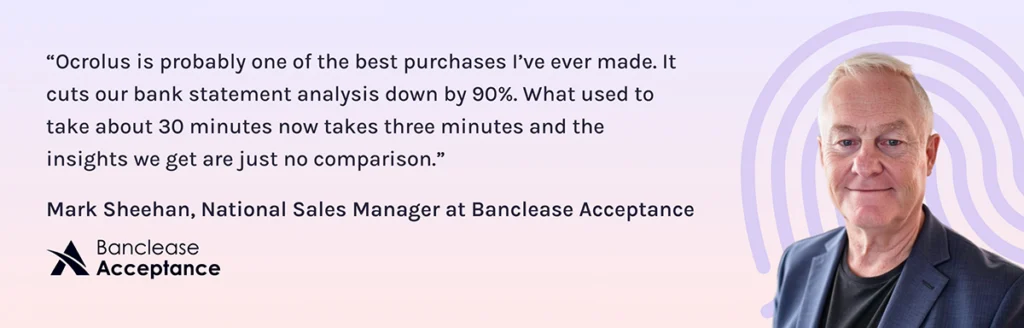
For Sheehan, the return on that shift has been unambiguous. “Ocrolus is probably one of the best purchases I’ve ever made,” he said. “It cuts our bank statement analysis down by 90%. What used to take about 30 minutes now takes three minutes and the insights we get are just no comparison.” He also credits the platform with delivering more than expected: “It does what it says it’s going to do and it actually delivers more than what we thought it was going to do.” For SMB and equipment finance lenders weighing manual review against automation, the calculation is the same one Banclease made. Time saved on statement review is time an underwriting team can spend catching what manual review never had the bandwidth to find, and consistency that used to depend on who reviewed the file now travels with every deal. Read the full Banclease case study for the details of the integration.
Key takeaways
- Banclease cut bank statement review time from about 30 minutes to three minutes per file, a 90% reduction, by automating analysis with Ocrolus.
- Manual review in spreadsheets made it hard to apply consistent underwriting scrutiny across applications and limited insight into borrower cash flow.
- Ocrolus is integrated directly into Banclease’s lease operating system, so borrower statements route automatically for analysis with no manual handoff.
- Roughly 1 in 8 applications Ocrolus processes for small business lenders contain a suspicious document, a consistent baseline across 1.46 million applications over 90 days.
- Ocrolus Detect helped Banclease catch manipulated bank statements before underwriters opened the file, strengthening fraud detection alongside faster review.
FAQs
What is automated bank statement analysis?
Automated bank statement analysis uses AI to extract data from bank statements, categorize transactions, capture balances and generate structured cash flow insights without manual review. Banclease Acceptance used Ocrolus to cut its bank statement review time by 90%, from about 30 minutes to three minutes per file.
How does Ocrolus detect fraud in bank statements?
Ocrolus Detect screens bank statements for signs of tampering and manipulation before an underwriter opens the file. Across small business lending applications, Ocrolus finds that roughly 1 in 8 contain a suspicious document requiring flagged review, a consistent baseline over recent 90-day periods.
How much time can automated bank statement analysis save lenders?
Results vary by lender, but Banclease Acceptance reduced bank statement review time from about 30 minutes to three minutes per file, a 90% reduction. The time saved lets underwriting teams analyze more deals while gaining deeper cash flow insight per file.
Why do manual bank statement reviews limit underwriting quality?
Manual review depends on individual analysts, so scrutiny varies across applications and portfolios. It also leaves little time to cross-check documents for tampering, since most of the reviewer’s time goes to reading and categorizing transactions rather than analyzing the data.


