How Beacon Funding detects bank statement fraud with Ocrolus
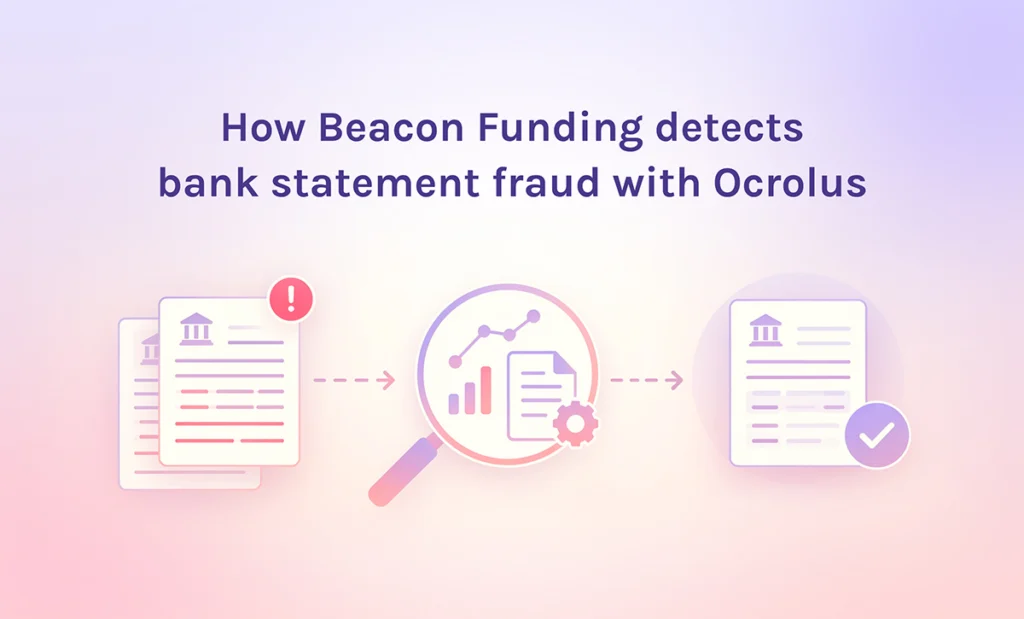
TL;DR: Manual review can catch obvious signs of bank statement tampering, such as inconsistent fonts or spacing, but it does not scale and misses subtler manipulation. Ocrolus data across 1.46 million small-business loan applications found that roughly one in eight contained a suspicious document, and equipment lender Beacon Funding Corporation now uses Ocrolus Detect’s automated authenticity scoring to flag manipulated bank statements instantly, blocking an average of $375,000 in fraudulent deals every month while cutting manual review time by more than five hours a week.
Roughly one in eight small-business loan applications Ocrolus reviewed over a recent 90-day span contained a suspicious document, a rate that held steady across the full period rather than spiking around any single event. Drawn from 1.46 million applications, that baseline means every file needs to be screened for tampering as a matter of routine, not flagged only when something looks obviously wrong. At Beacon Funding Corporation, an equipment financing company based in Northbrook, Illinois, that screening used to mean a trained eye, and in some cases a literal ruler, measuring the spacing between characters to catch a font swapped mid-document. That approach can work at a glance. It falls apart once volume climbs and fraudsters use the same PDF editing tools everyone else does.
What manual tampering checks catch and what they miss
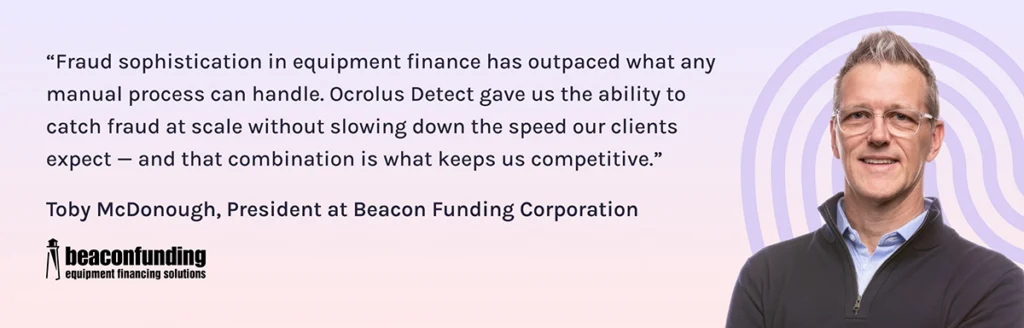
As bank statement tampering grew more sophisticated, Beacon Funding’s quick spot-checks turned into full manual inspections that still weren’t reliable at scale. “We were literally going up with a ruler to try and measure the spacing and font changes to spot inaccuracies in suspected fraudulent documents,” said Michael Arida, credit and syndications manager at Beacon Funding.
That process cost the credit team more than five hours a week in manual bank statement review alone. Every document that raised a flag added another 30 minutes of back and forth between credit and sales before a decision could move forward, a delay that worked directly against the same-day decisioning Beacon Funding’s clients expect. A trained analyst can catch an obviously mismatched font at a glance. What manual review can’t do is hold that same standard at volume, or scale without adding headcount every time application volume grows.
Automated authenticity scoring turns tampering signals into one number
Beacon Funding now runs every application through Ocrolus Detect, which checks bank statements for the same categories of tampering, font inconsistencies and spacing irregularities, and returns a single authenticity score. “When the authenticity score is high on a set of bank statements, we don’t have to dig into it nearly as much. We take a quick view and we trust the Ocrolus score,” Arida said. When a file does flag, the signal is unambiguous. “It lights up like a Christmas tree, showing if there are fraud issues,” he said. The 30-minute investigation that used to follow every flag is gone, replaced by a score the credit team can act on immediately.
Fraud screening is only half of what changed. Cash flow analytics and custom transaction tagging now break every applicant’s transactions into categories that map to Beacon Funding’s underwriting criteria, flagging stacking behavior, surfacing gambling activity and applying deal-specific tags that update in real time. “The addition of cash flow analytics with Ocrolus was a great cherry on top for us. It gives us a much deeper dive into what’s really happening in the business,” Arida said.
Why this matters beyond one equipment lender
Beacon Funding’s exposure is not an outlier. Across the broader lending market, 8.5% of documents submitted with loan applications show high-risk fraud signals. Within Ocrolus’s own customer base, the rate of suspicious documents runs higher, close to one in eight applications, which points to a customer base facing more fraud attempts, not one screening applications less carefully. Nationally, the broader picture explains why closing that gap matters: 44% of North American financial institutions primarily rely on manual processes to fight fraud, according to LexisNexis Risk Solutions’ latest research. Among US lending firms specifically, the cost of every dollar lost to fraud climbed from $4.16 in 2021 to $5.38 in 2025, a 29% increase in four years. Closing that gap has less to do with reviewing more documents by hand and more to do with changing what happens the moment a document arrives, before it ever reaches a person with a ruler.
For Beacon Funding, that shift produced a specific number: an average of $375,000 in fraudulent deals blocked every month, with full deal volume maintained by a credit team one-third smaller after a retirement went unreplaced. Clients still get a decision in three to four hours. None of that required the team to review more documents by hand. It required removing manual review as the bottleneck and letting an authenticity score run the first pass on every file, every time. The specific tagging categories Beacon Funding built around its underwriting model are in Beacon Funding’s full case study.
Key takeaways
- Document fraud in small-business lending is not rare: across 1.46 million applications, Ocrolus found that roughly one in eight contained a suspicious document.
- Manual signal-spotting, like checking fonts and spacing by eye, catches obvious tampering but does not scale and consumes hours of credit-team time every week.
- Automated authenticity scoring condenses tampering signals into one score credit teams can act on immediately, without a 30-minute investigation for every flag.
- Cash flow analytics and custom transaction tagging give lenders a deeper read on stacking behavior, gambling activity and deal-specific risk once fraud screening stops being manual.
- At Beacon Funding, moving from manual review to automated detection helped block an average of $375,000 in fraudulent deals a month while shortening, not lengthening, decision time.
FAQs
What are the most common signs of bank statement tampering?
The most common signs are font inconsistencies mid-document and uneven spacing between characters or line items, the kind of small formatting breaks that show up when a PDF has been edited after a bank issued it. Individually, either one can be explained away. Together, they’re the pattern automated authenticity scoring is built to catch.
Can a credit team reliably catch tampered documents by reviewing them manually?
At low volume, an experienced analyst can catch obvious tampering, like a font that clearly does not match the rest of a statement. It becomes unreliable at scale. Beacon Funding Corporation’s credit team spent more than five hours a week on manual bank statement review before automating the check, and every flagged file still triggered a 30-minute investigation.
How does automated bank statement fraud detection work?
Automated detection tools scan a document for the same categories of tampering a trained reviewer would look for, including font changes and spacing irregularities, then combine those signals into a single authenticity score. A high score lets a credit team move forward with minimal review, while a flagged score routes the file for closer inspection.
What is the difference between fraud detection and cash flow analysis in loan underwriting?
Fraud detection determines whether a submitted document is authentic. Cash flow analysis, which includes transaction tagging and categorization, determines what the numbers in that document actually say about an applicant’s business. Lenders typically need both: one confirms the data is real, the other decides what to do with it.
How much fraud can automated detection realistically catch?
The answer depends on volume and risk profile, but real examples give a sense of scale. Beacon Funding Corporation, an equipment financing company, now blocks an average of $375,000 in fraudulent deals a month using Ocrolus Detect, up from a manual process that struggled to keep pace with loan volume.


