Why vertical AI is mission-critical for lenders
TL;DR: Most enterprise generative AI pilots lack measurable impact. Lenders succeed with vertical AI built for lending data, compliance, and workflows, not a generic horizontal solution.
AI hype has outpaced outcomes. On Aug. 18, 2025, Fortune reported MIT’s NANDA finding that about 95% of enterprise genAI pilots show little or no impact on P&L. For lenders operating with thin margins and strict oversight, that gap underscores a simple truth: results hinge on vertical AI, not generic horizontal tools.
Understand the difference
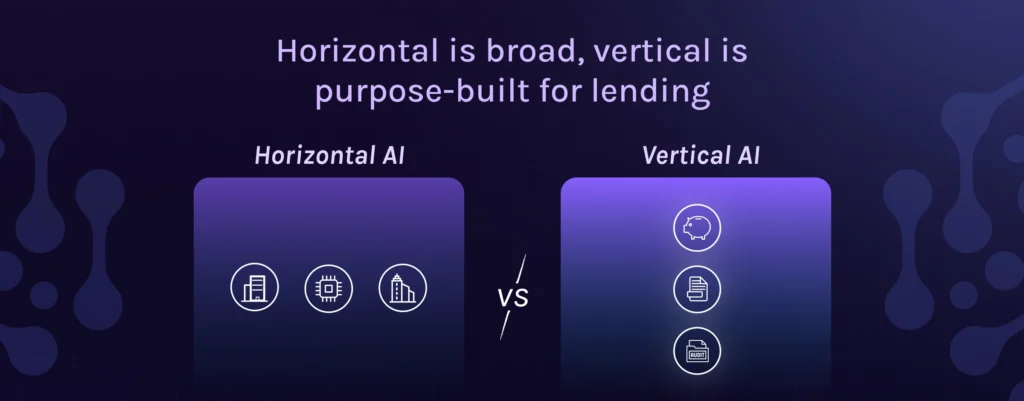
Horizontal AI refers to broad, general-purpose platforms meant to work across industries. Vertical AI is trained on sector data, rules and workflows, which makes it fit for regulated, domain-specific decisions. Gartner notes that while general-purpose models can handle broad use cases, higher-value enterprise needs often require industry-specific data and domain expertise, pushing organizations toward vertical solutions.
For lenders, this distinction is practical, not academic. Lending success depends on accurate document understanding, explainable decisions and audit-ready outputs that integrate with loan origination workflows. For a deeper primer on lender use cases, explore our AI resource center.
Why horizontal AI falls short for lenders
Generic models struggle with industry-specific documents, data formats and regulatory nuance, which creates accuracy gaps in underwriting and verification. The heavier risk is compliance. Financial institutions face expectations for transparency, explainability and audit trails. CFA Institute’s 2025 guidance urges the financial sector to prioritize explainability to safeguard trust and regulatory compliance.
U.S. banking stakeholders echo the need for model risk management that addresses reliability, bias and explainability. Commentary in the ABA Banking Journal highlights how AI-driven models challenge traditional validation, raising questions about model reliability, transparency and explainability that banks must manage.
Pilots fail when tools are not designed for mission-critical lending workflows where precision and oversight are non-negotiable. Horizontal AI can demonstrate impressive capabilities, yet without domain training and workflow fit, it rarely converts to measurable ROI. The path forward is specialization.
How vertical AI delivers where it matters
Vertical AI transforms messy borrower documentation into clean, review-ready data with high fidelity, then exposes transparent reasoning suitable for examiner scrutiny. It understands the difference between a bank statement and a pay stub, detects signs of manipulation and aligns outputs to lending rules your teams already follow. Crucially, vertical AI integrates with loan origination systems and lender workflows, so institutions adapt less and achieve value faster. For strategy context, see how verticalization drives outcomes in vertical AI in financial services and practical benefits.
This approach also aligns with emerging risk-management practice. NIST’s AI Risk Management Framework and evolving profiles for generative AI emphasize governance and transparency, themes lenders already recognize from model risk programs.
The competitive advantage
Lenders today face higher volumes, tighter margins and stricter oversight. Vertical AI enables faster decisions without sacrificing risk management, strengthens fraud vigilance and improves borrower experience through consistent, auditable decisions. That is why many financial services leaders frame vertical AI as mission-critical: it embeds domain logic and compliance expectations into daily operations, which is the standard lenders must meet to realize ROI. For practical outcomes and benchmarks, review our latest customer stories.

Separating hype from reality
Horizontal AI may headline the news, but lenders need results they can document and defend. The MIT finding that 95% of pilots miss financial impact is not an indictment of AI; it is a signal to choose domain-specific solutions, robust governance and tight workflow integration.
When evaluating partners, prioritize three factors: proven domain expertise in lending processes, data fidelity across document types and integration with existing workflows. Ocrolus, an AI-powered data and analytics platform, encourages lenders to start with use cases that demand accuracy, transparency and measurable cycle-time improvement.
Key takeaways
- MIT’s NANDA finding shows about 95% of enterprise genAI pilots lack P&L impact, which raises the bar for lender-focused AI adoption
- Gartner underscores that higher-value enterprise needs often require industry-specific data and domain expertise, favoring vertical AI
- Financial sector guidance prioritizes explainability and auditability, making transparency essential in lending AI programs
- Lenders should evaluate AI partners on domain expertise, data fidelity and workflow integration to achieve measurable results


