Cash flow intelligence: the data moat behind better SMB credit decisions
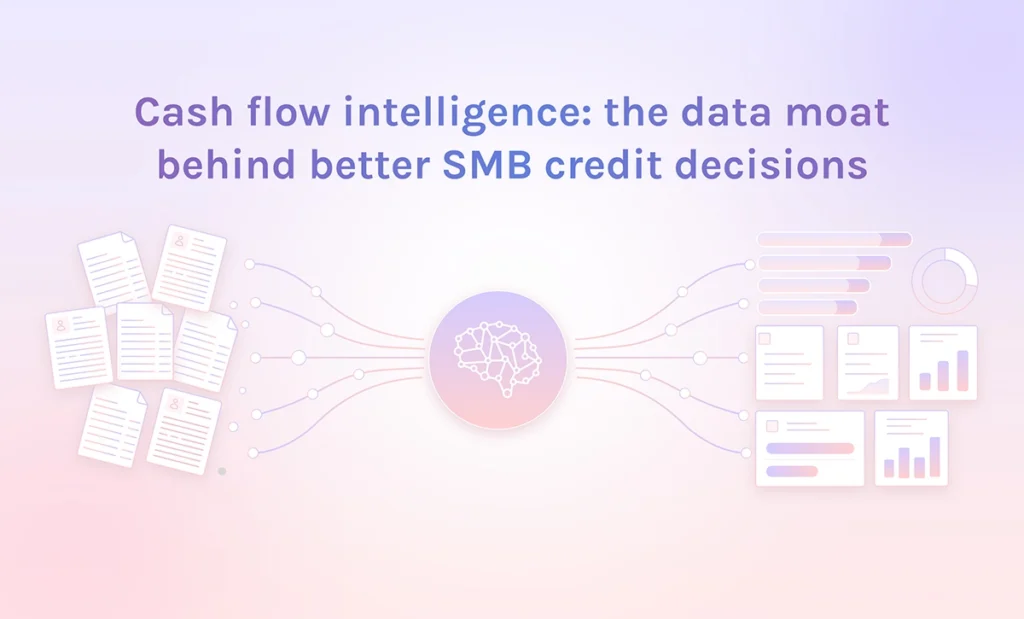
TL;DR: Cash flow intelligence transforms raw bank statements and digital-transaction data into standardized, model-ready credit signals for small-business lending. Ocrolus analyzes roughly 750,000 credit applications a month, producing the largest SMB cash-flow dataset in the industry — the foundation for more predictive risk models, more accurate approvals and healthier portfolios.
Bank statements hold the richest signal a small-business lender has. They show revenue, spending, debt, liquidity and volatility at transaction-level granularity. They are also the least decision-ready data in the stack — PDFs of varying quality, inconsistent descriptions, mixed counterparties and no common schema across the thousands of banks that small businesses rely on. Cash flow intelligence closes that gap. It converts raw bank activity into a structured set of features, ratios and risk signals that credit teams can model against directly. The accuracy of those signals depends on one thing above everything else: the size and variety of the SMB cash-flow dataset behind the classification and enrichment engines that produce them.
Why dataset scale is the moat
Transaction classification is a data-hungry problem. The more SMB bank profiles a platform has processed, the more accurately it resolves counterparties, identifies merchant identity, maps transactions to NAICS industry codes, detects fintech loans and merchant cash advances and flags stress events like NSF and overdraft activity. A narrow dataset mislabels transactions, misses debt obligations and under-detects risk. A broad one learns the edge cases — the seasonal HVAC contractor, the restaurant group with multiple DBAs, the trucking operator running stacked merchant cash advances.
Ocrolus processes roughly 750,000 credit applications each month and has been engineering purpose-built financial AI models since 2016. That volume is what makes the resulting cash-flow features usable in production credit decisions rather than just spot-check underwriting. It is also what enables standardization: a common language for interpreting bank data across the SMB funding ecosystem. Without that common language, every lender rebuilds the same transaction-classification infrastructure in parallel, and every downstream credit model is only as strong as the noisy inputs feeding it.

From transactions to decision-ready analytics
Cash flow intelligence is not a single metric. It is a structured profile built from transaction-level data, expressed across the categories credit teams actually use. Revenue analytics capture total and average monthly revenue, top counterparties and concentration — the stability side of the cash-flow picture. Expense analytics do the same for outflows, surfacing vendor dependency and shifts in cost structure over time. Debt and financing signals identify loan proceeds, loan payments, fintech lenders and MCA providers already in the stack, exposing obligations that pure credit-bureau data routinely misses.
Liquidity metrics, such as average daily balance, tell a credit team whether the business can absorb a new payment. Risk indicators — NSF count, overdraft fee count and total overdraft amount — flag stress before it shows up in a delinquency file. A single derived ratio, the debt coverage ratio, expresses repayment capacity in a form that underwriters and models can compare across an entire portfolio. Together, these categories form a decision-ready cash-flow profile rather than a stack of unstructured documents.
Sharper inputs, better risk models
Credit models are only as strong as their features. Lenders building and refining proprietary credit risk models need inputs that are consistent across applications, stable over time and rich enough to separate good borrowers from marginal ones. Standardized cash-flow features deliver on all three. Industry classification via NAICS codes allows industry-adjusted underwriting, so a restaurant is not scored against the same benchmarks as a trucking operator. Debt-capacity calculations ground line sizing in observed cash flow rather than self-reported revenue. Stress indicators let risk teams segment borrowers before a decision is made rather than after a default hits the books.
When these features come from the largest SMB cash-flow dataset in the industry, the signal-to-noise ratio is high enough to support production modeling, continuous portfolio monitoring and real early-warning signals that risk teams can act on. This is the difference between using cash flow data as a nice-to-have and using it as the core layer of a credit decision engine that compounds accuracy every time it runs.
Small-business lending is a speed-and-accuracy game, and the lenders winning in the current cycle are extracting the most signal per document. Cash flow intelligence grounded in a dataset large enough to be authoritative is the shortest path there. It replaces manual review with standardized analytics, reduces approval variance across underwriters and gives risk teams the feature set they need to keep portfolios healthy through every cycle — not just the easy ones. That durability — the ability to hold up through expansion, stress and recovery — is ultimately what separates a data provider from a decision intelligence platform.
Key takeaways
- Cash flow intelligence converts raw bank-statement data into standardized, model-ready credit signals for SMB lending.
- Classification accuracy scales with dataset size; volume and variety are the moat behind reliable cash-flow analytics.
- A decision-ready cash-flow profile spans revenue, expenses, debt and financing, liquidity, stress indicators and repayment capacity.
- Standardized features give risk teams consistent inputs for building and refining proprietary credit risk models.
- Ocrolus processes roughly 750,000 credit applications a month — the largest SMB cash-flow dataset in the industry.
FAQs
What is cash flow intelligence?
Cash flow intelligence is the structured financial analytics derived from raw bank-statement and digital-transaction data. It converts transaction-level activity into a standardized set of features, ratios and risk signals — revenue, expenses, debt, liquidity, stress indicators and repayment capacity — that credit teams can use directly in underwriting and risk models.
Why does SMB cash-flow dataset size matter for credit modeling?
Transaction classification improves with volume. A platform that has processed more SMB bank profiles resolves counterparties more accurately, detects more edge-case loan and MCA obligations and flags stress events more reliably. Larger datasets also enable standardization, giving lenders a common language for interpreting bank data across the SMB funding ecosystem.
What metrics make up a decision-ready cash-flow profile?
A cash-flow profile typically includes revenue analytics (total, average monthly, counterparties, concentration), expense analytics, debt and financing signals (loan proceeds, loan payments, fintech and MCA sources), liquidity metrics like average daily balance, stress indicators such as NSF and overdraft events and the debt coverage ratio.
How is cash flow intelligence different from credit bureau data?
Credit bureau data captures tradeline-level history but often misses fintech loans, merchant cash advances and day-to-day volatility that live inside bank activity. Cash flow intelligence reads those signals directly from transactions, exposing obligations, stress patterns and liquidity positions that bureau files do not.


