Borrowers don’t see your tech stack. They feel it – and it costs you.
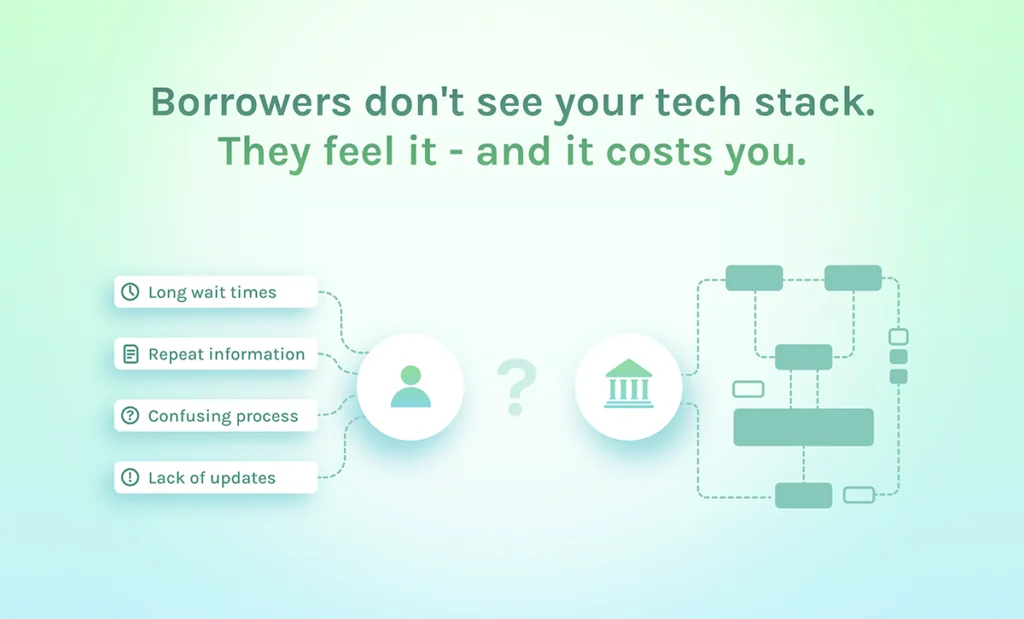
TL;DR: This post examines how mortgage borrower experience is shaped primarily by back-office processing quality rather than borrower-facing technology. Repeated document requests, long cycle times and slow stip resolution are the friction points borrowers feel most acutely — and AI-driven document processing and income verification directly address them. Ocrolus provides AI-powered document processing and analytics for mortgage lenders working to improve cycle times and borrower pull-through.
The borrower experience in mortgage doesn’t begin when a loan officer picks up the phone — and it doesn’t end when the application is submitted. The moments that shape a borrower’s perception happen in between: the three-day wait after they uploaded documents, the second request for a paystub they already provided, the email asking for something the processor should already have. These are moments lenders rarely see, because they happen inside workflows rather than in front of customers. But borrowers feel every one of them. And in a purchase market where pull-through matters as much as origination volume, that feeling translates directly into closed loans, referrals and long-term retention.
The front end isn’t the friction
Lenders have invested heavily in borrower-facing technology over the past decade — digital applications, mobile portals, e-signature workflows. Most of it meaningfully improved the intake experience. But a polished digital front door that opens into a slow, document-heavy back office hasn’t improved the borrower experience. It’s moved the frustration downstream.
The moments borrowers remember are rarely at the start of the process. They remember calling their LO three weeks in to ask what’s happening. They remember uploading the same document twice. They remember a conditional approval that felt, to them, like starting over. These aren’t communication failures. They’re process failures, and they originate in the back office — in how quickly documents are processed, income is calculated and stipulations are resolved.
Mortgage cycle times remain long enough that processing delays — not origination delays — are often the defining factor in how borrowers experience the transaction. Every day a file sits waiting for a human to extract income from a complex tax return or reconcile bank statement data is a day borrower confidence quietly erodes.
What borrowers are actually measuring
The trust signal in mortgage, once a borrower has committed to a lender, isn’t the rate. It’s speed. How quickly things move. How few times they’re asked for something they’ve already given. How linear and predictable the path to close feels.
A second or third documentation request doesn’t register as a neutral administrative ask. Borrowers hear disorganization. They hear that their time wasn’t valued. Both impressions damage the relationship — and the pull-through rate. J.D. Power’s U.S. Primary Mortgage Origination Satisfaction Study consistently finds that process experience, not final rate, is a primary driver of repeat business and referrals in residential lending.
Lenders often treat these moments as an inevitable cost of mortgage complexity. But documentation rework that triggers a second stip request usually has a specific cause: income not fully reconciled on first pass, data entered manually with errors, or document classification that required human intervention. These aren’t unavoidable problems. They’re problems AI in mortgage underwriting is specifically built to solve.
Where AI changes the experience without being seen
The automation investments that improve borrower experience are invisible to borrowers. There’s no feature they click on. The improvement shows up as a faster conditional approval, a stipulation list that doesn’t grow and a process that doesn’t circle back.
When a lender can automatically classify complex documents, calculate income across multiple sources and surface inconsistencies before they become stipulations, files move faster. LOs spend less time chasing documentation. Underwriters spend more time on credit judgment and less on data extraction. Ocrolus processes roughly 750,000 credit applications a month using purpose-built AI models trained on financial documents — models engineered for the complexity that defines mortgage underwriting, from W-2s and tax returns to bank statements and pay stubs across multiple employers.
Lenders treating back-office AI as an operational efficiency play are capturing a second benefit they may not be actively tracking: a materially better borrower experience and a pull-through rate that reflects it.
The signals borrowers use to evaluate their lender — speed, clarity, fewer asks — are almost entirely functions of how well the back office operates. That’s not a technology argument. It’s an experience argument, and it has direct implications for how lenders should think about where AI investment delivers real returns. The lenders gaining ground in pull-through and referrals aren’t necessarily the ones with the best front-end technology. They’re the ones whose back-office processing is fast, accurate and automated enough that borrowers never feel the friction. The AI your borrowers never see is the AI that changes how they feel about you.
Key takeaways
- The mortgage borrower experience is shaped primarily by back-office processing quality — not the sophistication of borrower-facing technology.
- Repeated document requests are the most corrosive friction point borrowers experience, and they typically trace back to specific, solvable processing failures.
- Speed functions as a trust signal in mortgage lending; how fast a lender moves shapes borrower confidence as meaningfully as the final rate.
- AI that automates document classification, income calculation and stip resolution improves borrower experience indirectly but measurably — fewer asks, faster closes and cleaner conditional approvals.
- Lenders investing in back-office AI capture a pull-through and referral benefit that may not show up in operational efficiency metrics alone.
FAQs
What is mortgage pull-through rate and why does it matter for borrower experience?
Pull-through rate is the percentage of mortgage applications that successfully reach closing. Borrower experience directly affects pull-through: friction points like repeated document requests, slow approvals and unclear process timelines increase the likelihood that borrowers abandon before close or choose a competing lender. Reducing back-office processing delays is one of the most direct ways to improve pull-through.
Why do mortgage borrowers receive repeated document requests?
Repeated document requests typically result from specific back-office processing failures — income not fully reconciled on the first review, manual data entry errors, or document classification that required human re-handling. These aren’t inherent to mortgage complexity. AI-powered document processing and income verification address these failure points at the source, reducing the need for follow-up requests.
How does AI improve the mortgage borrower experience?
AI improves the mortgage borrower experience by accelerating and automating the back-office processes that borrowers feel as delays and repeated asks. Automated document classification, income calculation and stip resolution reduce cycle times, minimize rework and eliminate most of the reasons a processor needs to go back to a borrower for more documentation. The borrower never interacts with the AI — they experience it as a faster, cleaner process.
What is the biggest driver of borrower satisfaction in mortgage lending?
According to J.D. Power’s U.S. Primary Mortgage Origination Satisfaction Study, process experience — not final interest rate — is among the top drivers of borrower satisfaction, repeat business and referrals. Borrowers who experience an organized, fast and low-friction process are significantly more likely to return to the same lender and recommend them to others.
What is mortgage cycle time and how does it affect borrower satisfaction?
Mortgage cycle time is the number of days from application to close. Longer cycle times increase borrower anxiety and the likelihood of a competitor poaching the deal. Processing delays — driven by manual document review, income calculation and stip resolution — are a primary contributor to extended cycle times and are directly addressable through back-office automation.


